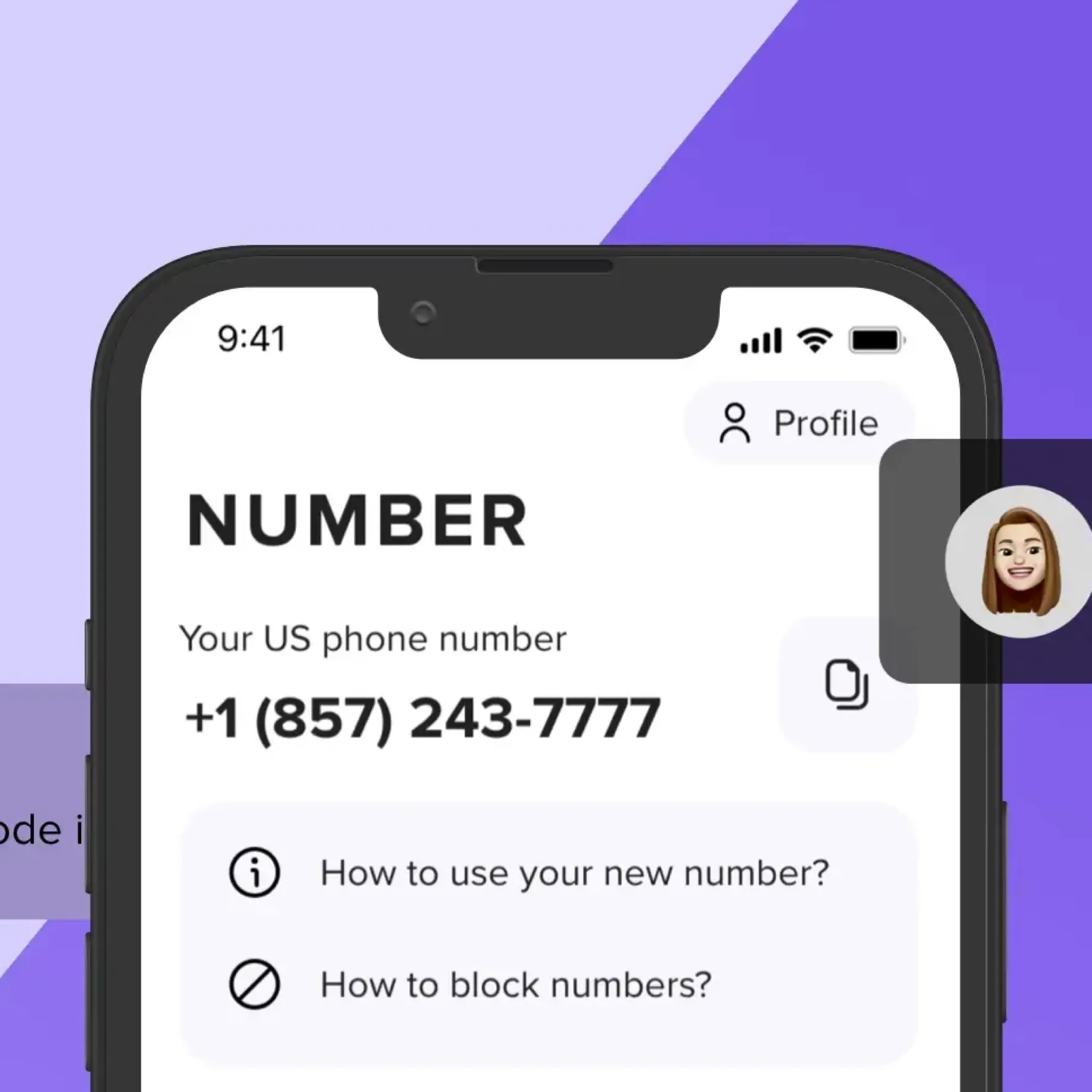
Key Takeaways:
• What it is: A virtual number is a real, dialable phone number anchored to the cloud rather than to a SIM card. It uses VoIP (Voice over Internet Protocol) to route calls and SMS over the internet.
• How it differs from a carrier number: A carrier number lives on a SIM tied to your real identity at a regulated carrier. A virtual number lives in a cloud account and is not linked to your name or address.
• Why it matters in 2026: Virtual numbers are SIM-swap immune, work across devices, support international use without roaming fees, and accept SMS verification for major apps like WhatsApp and PayPal.
• Quick next step: Download the SLYNUMBER app on iOS or Android, or visit slynumber.com/app/register to claim a real U.S. virtual number in under 5 minutes.
1. What is a virtual number?
A virtual number is a real, dialable phone number that routes calls and text messages over the internet rather than through a cellular tower and a SIM card. The underlying technology is Voice over Internet Protocol (VoIP) — in plain terms, phone calls delivered as encrypted data packets over your Wi-Fi or mobile data connection instead of through a carrier's voice network. The U.S. Federal Communications Commission regulates VoIP services under its standard VoIP framework, so virtual numbers operate inside the same numbering and emergency-services rules as traditional phone lines.
Because a virtual number is not bound to a physical SIM, it can work on any device with an internet connection: an iPhone, an Android phone, a tablet, or a laptop. You receive standard SMS and MMS messages, place voice calls, and verify app accounts — all through a dedicated app rather than your carrier's dialer. SLYNUMBER provisions virtual numbers from the regulated North American Numbering Plan, so the numbers are functionally identical to carrier numbers for SMS-verification, voicemail, and inbound/outbound calling — but anchored to a cloud account that is not linked to your real identity.
2. How a virtual number works
The Cloud Switch Replaces the Carrier Switch
Traditional phone numbers are anchored to a carrier's switch — a specialized piece of network infrastructure that routes calls and SMS to the SIM card associated with your account. A virtual number is anchored to a software switch in a data center. When someone calls or texts the number, the provider routes the traffic over the internet to the app on whichever device you are signed in to.
VoIP Carries Voice; SMS Gateways Carry Messages.
For voice calls, your app encodes audio into packets and transmits them over Secure Real-Time Transport Protocol (SRTP), which encrypts voice data in transit. For SMS and MMS, the provider connects to the SS7 messaging gateways the wider carrier network uses, which is why a SLYNUMBER can receive standard verification codes from WhatsApp, your bank, Tinder, and other services that rely on SMS-2FA.
Authentication Lives in Your Cloud Account
Instead of authenticating to the network by presenting an IMSI from a SIM, you authenticate to the SLYNUMBER service by signing into your account in the app. Because there is no SIM and no IMSI exposed to a carrier rep, there is no SIM-swap pathway — the attack vector requires a SIM-and-IMSI relationship that does not exist for a virtual number.
Encryption End to End
Calls and messages are transmitted over Transport Layer Security (TLS) — the same encryption that protects online banking — plus SRTP for voice. The number's traffic is encrypted in transit between your device and the provider's switch, which limits the kinds of passive interception attacks that older protocols such as SS7 are vulnerable to.
3. Risks the carrier model leaves open
Carrier numbers are not bad — they are simply optimized for a different threat model. Three concrete risks built into the carrier model are exactly what a virtual number is designed to neutralize.
-
SIM swapping on carrier-controlled numbers
The SIM-swap attack exploits the IMSI-to-ICCID mapping inside a carrier's database. A scammer impersonates you to a carrier rep — usually using personal data from breaches — and convinces the rep to transfer your number to a SIM the attacker controls. Every call and SMS that follows (including 2FA codes for banks and crypto exchanges) goes to the attacker's device.
The FBI's Internet Crime Complaint Center (IC3) reported SIM-swap losses growing from roughly $12 million in 2018 to over $72 million in 2022 — a sixfold increase, driven by attacks on bank, email, and cryptocurrency accounts that use SMS-based 2FA on carrier numbers.
Why a SLYNUMBER helps: A SLYNUMBER has no SIM and no carrier rep to socially engineer. The number is anchored to a cloud account, so the SIM-swap attack chain does not apply.
-
SMS-2FA tied to a single carrier line
Banks and high-value services routinely send 2FA codes by SMS — but to your single carrier number. The U.S. National Institute of Standards and Technology has been warning about this pattern for years: SMS over carrier networks is vulnerable to SS7 protocol interception and to SIM-swap social engineering, and yet it remains the default for many banks because of consumer familiarity.
The U.S. National Institute of Standards and Technology's Special Publication 800-63B classifies SMS-based 2FA as a "restricted" authenticator and explicitly warns about SIM-swap and SS7 interception as known weaknesses.
Why a SLYNUMBER helps: Moving SMS-2FA to a SLYNUMBER pulls it off the carrier line. SLYNUMBER traffic rides over TLS and SRTP between your device and the cloud switch, eliminating the SS7 layer and the SIM-swap social-engineering pathway in one move.
-
Caller-ID spoofing on widely known carrier numbers
Caller-ID spoofing is when scammers use software to forge the displayed number on outgoing calls — making it look as though a call is coming from a bank, a government agency, or even your own number. Once your real carrier number is widely known (through breaches, marketplaces, or directory scraping), it becomes a more attractive source for spoofers and a more attractive target for impersonation scams aimed at people who know you.
The FTC's 2023 Consumer Sentinel Network data recorded impersonation fraud (often relying on spoofed caller ID) as the year's top reported scam category, with $2.7 billion in reported consumer losses.
Why a SLYNUMBER helps: While no number type can fully prevent outbound spoofing, keeping your real carrier number out of public-facing accounts shrinks the attack surface. A SLYNUMBER used for sign-ups, marketplaces, and dating absorbs the public exposure instead.
4. Everyday uses for a virtual number
App Sign-Ups Without Long-Term Exposure
Use a virtual number for newsletter sign-ups, free trials, marketplace listings, ride-share accounts, and dating apps. If one of those services is breached, the leaked number leads to a cloud account — not to your real identity, your bank, or your family contacts. Your carrier line stays out of the public-data lifecycle entirely.
A Second Line on a Single Device
A virtual number gives you a second phone number on your existing iPhone or Android — separate caller ID, separate SMS inbox, separate voicemail — without a SIM swap, a carrier appointment, or a second device. Tag the line "Business," "Dating," "Travel," or "Marketplace" and switch between numbers with one tap.
International Use Without Roaming Fees
Because a virtual number runs over the internet, it rings on hotel Wi-Fi in Tokyo just as easily as on home Wi-Fi in Austin — no carrier roaming charges, no carrier handoff, no "I'll call you when I land." SLYNUMBER also offers eSIM data plans in 150+ countries so you can get local cellular data while traveling without buying a tourist SIM.
5. How to set up a virtual number in 5 steps:
- Download the app. Install SLYNUMBER from the App Store (iOS) or Google Play (Android).
- Create an account. Sign up with an email address. No carrier information or government ID is required.
- Choose your virtual number. Pick a real U.S. mobile number and select any available area code — 212 for New York, 305 for Miami, 415 for San Francisco — independent of where you physically live.
- Select a plan. Plans start at $4.99 per month on the quarterly billing cycle ($14.99 billed every three months). Monthly and annual options are also available.
- Start using your virtual number. Make calls, receive SMS verification codes, set up custom voicemail, and activate apps — all from inside the SLYNUMBER app, on any device with an internet connection.
6. Virtual number vs. other options
Here is how a virtual number from SLYNUMBER compares with the major alternatives across the features that matter most for long-term use:
| Feature |
SLYNUMBER |
Google Voice |
Burner Apps |
Carrier 2nd line |
| Real U.S. mobile number | Yes | No | Varies | No |
|---|
| SMS verification for apps | Yes | Limited | Often blocked | Yes |
|---|
| Immune to SIM swapping | Yes | Yes | Yes | No |
|---|
| Custom voicemail | Yes | Yes | Rarely | Yes |
|---|
| International calling | Yes | Limited | Rarely | Carrier dependent |
|---|
| eSIM / Data plans | Yes | No | No | Carrier dependent |
|---|
| Number permanence | Permanent | Permanent | Temporary | Permanent |
|---|
| Requires carrier number | No | Yes | Varies | Yes |
|---|
| Starting price | $14.99 / 3 months | Free | $2–$5/week | $10–$15 add-on |
|---|
Quick recap: SLYNUMBER provides real U.S. mobile numbers starting at $14.99 every three months, accepts SMS verification for all major apps (WhatsApp, banking, social media), is immune to SIM-swap attacks because the number is not held by a carrier, and includes eSIM data plans in 150+ countries. Google Voice is free but ties to an existing U.S. carrier number and issues VoIP-flagged numbers with limited app verification. Burner apps ($2–$5/week) issue temporary numbers major services often block. A carrier 2nd line ($10–$15 add-on) gives a real number but inherits SIM-swap risk and requires an active carrier account.
7. Features and pricing
Core Features
SLYNUMBER provides real U.S. mobile numbers — not the VoIP-flagged numbers that apps and services routinely block. Each virtual number supports:
• SMS and MMS messaging, including app-verification codes
• Inbound and outbound voice calls
• Custom voicemail greetings
• Call routing, forwarding, and per-contact blocking
• International calling to 100+ countries
• Number tagging by purpose: business, personal, dating, or travel
• eSIM data plans for cellular connectivity in 150+ countries without a local SIM
SLYNUMBER virtual numbers are accepted by every major app tested, including WhatsApp, Telegram, PayPal, Venmo, Instagram, Snapchat, Tinder, Bumble, Amazon, and Gmail.
Security
Calls and messages are transmitted over encrypted connections using Transport Layer Security (TLS) and Secure Real-Time Transport Protocol (SRTP). The number is not linked to your legal name, home address, or billing details, so reverse-lookup tools cannot map it back to your real identity.
Pricing
SLYNUMBER offers three billing cycles, all of which include the same full feature set:
• Quarterly: $4.99/month, billed as $14.99 every three months
• Annual: $49.99/year — lowest per-month rate
• Add-on credits: $10 for 1,000 credits (1 credit = 1 minute call, 1 SMS, or 1 MMS)
Platform availability
The SLYNUMBER app is available on the App Store and Google Play Store. SLYNUMBER also includes SlyAI, a built-in AI assistant for instant help and conversational support inside the app.
8. Frequently asked questions
A virtual number is a real, dialable phone number that is anchored to a cloud-based switch instead of a physical SIM card. Calls and SMS travel as encrypted data packets over Wi-Fi or mobile data using Voice over Internet Protocol (VoIP). You receive calls, send SMS, and verify apps through a dedicated app on any iPhone, Android, tablet, or laptop with an internet connection.
Yes. SLYNUMBER virtual numbers are real U.S. mobile numbers provisioned from the regulated North American Numbering Plan — the same numbering system used by Verizon, AT&T, and T-Mobile. They appear on caller ID like any other U.S. mobile number, accept SMS verification codes, and can be ported to other carriers.
A virtual number is bound to a software switch in a data center rather than a SIM card. When someone calls or texts the number, the provider routes the traffic over the internet to the SLYNUMBER app on whichever device you are signed in to. Calls and SMS travel as encrypted data packets using Transport Layer Security (TLS) and, for voice, Secure Real-Time Transport Protocol (SRTP).
Yes. SLYNUMBER issues real U.S. mobile numbers, so SMS verification codes from WhatsApp, Telegram, PayPal, Venmo, Tinder, Bumble, Instagram, Snapchat, Amazon, and major banks arrive in the SLYNUMBER inbox the same way they would on a carrier line. This is one of the key differences between SLYNUMBER and free VoIP services that issue numbers apps often reject.
For specific threats, yes. A virtual number is not held by a mobile carrier, so the SIM-swap attack vector does not apply. It is also not linked to your legal name, home address, or billing details — so reverse-lookup tools cannot map it back to your real identity. You still need a strong password and app-based 2FA on your provider account.
SLYNUMBER plans start at $4.99 per month on the quarterly billing cycle ($14.99 billed every three months). An annual plan is available at $49.99/year. Every plan includes calling, SMS, MMS, voicemail, call forwarding, and international dialing — all on a real U.S. mobile number with no physical SIM required.