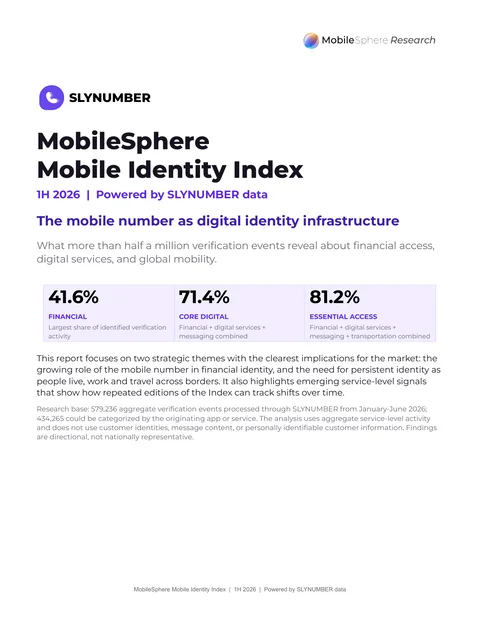
MobileSphere Mobile Identity Index: Financial Services Drive 41.6% of Mobile Verification Activity in 1H 2026
New research powered by SLYNUMBER data analyzes 579,236 verification events and finds that financial, digital services and messaging together account for 71.4% of identified activity, while AI services and international messaging post the strongest growth signals
By MobileSphere Research·Published September 16, 2026·8 min read
Cambridge, Mass., September 16, 2026 — MobileSphere, the Cambridge, Massachusetts-based mobile communication and software company behind the SLYNUMBER second mobile number app, today released the MobileSphere Mobile Identity Index for the first half of 2026, a new research series that tracks how consumers use their mobile number as a credential for everyday digital life. Powered by SLYNUMBER data, the 1H 2026 Index analyzes 579,236 aggregate verification events processed between January 1 and June 30, 2026, and finds that financial services were the single largest category of mobile verification activity, at 41.6% of identified events — more than twice the share of any other vertical.
Financial services, digital services and messaging together accounted for 71.4% of identified verification activity. Adding transportation brings the share of what the report calls essential access to 81.2%, evidence that the mobile number now operates less like a simple communications endpoint and more like identity infrastructure for banking, payments, digital platforms and travel.
41.6%FinancialLargest share of identified verification activity
71.4%Core digitalFinancial + digital services + messaging combined
81.2%Essential accessFinancial + digital services + messaging + transportation
Research base: 579,236 aggregate verification events processed through SLYNUMBER from January to June 2026; 434,265 could be categorized by the originating app or service. The analysis uses aggregate service-level activity and does not use customer identities, message content or personally identifiable customer information. Findings are directional, not nationally representative.
Four conclusions stand out
Financial access is the strongest mobile identity use case in the dataset. Banking, payments, account linking, credit and money-movement services — including Venmo, PayPal, Chime, Capital One, Bank of America, U.S. Bank, Wells Fargo and Zelle, alongside Plaid, Link by Stripe, Affirm, Klarna, Afterpay, Brigit and Dave — repeatedly appear among the most active sources of verification. Financial services led every month of the half and gained 9.7 percentage points of share between January (38.1%) and June (47.8%).
Mobile identity increasingly moves with the user. Messaging gained 4.4 points of share as travel accelerated, rising from 10.1% in January to 14.5% in June. During the World Cup period, WhatsApp reached a record level of new sign-ups in the dataset, while Line, Telegram and Viber reached record or near-record activity.
Real-world events leave a measurable identity fingerprint. Tax season, economic pressure, travel surges and major global events corresponded with shifts in verification behavior.
Emerging service trends can be detected in aggregate activity. OpenAI-related new service activations rose from 119 in May to 175 in June, both records in the dataset, moving AI from an emerging signal toward a recurring mobile identity use case.
“The first half of 2026 shows the mobile number operating less like a simple communications endpoint and more like a credential for everyday digital life. Financial services were the largest observed category, while digital services and messaging together pushed the share of core digital access well above 70% of identified verification activity.”
Where mobile identity shows up
Across the first half of 2026, identified verification activity was concentrated in the services consumers use to manage money, access digital platforms, communicate and move through daily life. Financial services accounted for 41.6% of identified activity, followed by digital services (18.8%), messaging (11.0%), social (10.7%), transportation (9.8%) and shopping (6.0%).
1H 2026 verification mix by verticalShare of identified verification activity, January–June 2026 (n = 434,265)
Financial41.6%
Digital services18.8%
Messaging11.0%
Social10.7%
Transportation9.8%
Shopping6.0%
Other2.0%
View the data as a table
Vertical
Share of identified activity
Financial
41.6%
Digital services
18.8%
Messaging
11.0%
Social
10.7%
Transportation
9.8%
Shopping
6.0%
Other
2.0%
The category mix reflects aggregate activity across the SLYNUMBER platform, not the population at large. It is most useful as a directional signal showing which kinds of digital services rely heavily on phone-based identity and how those patterns shift over time.
Inside the verticals
Financial services and banking: 41.6% share, up 9.7 points
Financial services are the clearest evidence that the mobile number has become part of digital identity infrastructure. The category includes banks, payment apps, bank-linking services, credit products and cash-flow tools, all of which use mobile verification to establish or restore access, confirm account activity and move money. Financial services led every month of the half and finished June at 47.8% of identified activity.
For banks, the report draws four implications: the phone number is not merely a contact field but supports account access, fraud communications, authentication, recovery and customer continuity; customers who change countries, carriers or phone plans may experience identity friction even when they have working data connectivity; mobile-number continuity belongs in the customer-experience conversation, especially for travelers, expatriates and customers with cross-border lives; and the shift toward passkeys and app-based authentication changes the verification method without eliminating the need to bind people, devices and accounts to trusted identity signals.
Digital services: 18.8% share, with AI as the emerging signal
Digital services remained the second-largest vertical. The category includes major platforms such as Google and Microsoft, as well as AI services and other digital platforms that use mobile verification for onboarding, access and account recovery. AI became a notable emerging signal, with OpenAI-related activity accelerating during the latter part of the period. The report's reading is that new digital categories do not replace identity infrastructure; they add new places where identity must work reliably, and the value of a mobile identity becomes cumulative as one number connects a person to many unrelated services across work, finance and personal life.
Messaging and communications: 11.0% share, up 4.4 points
Messaging is where the connection between mobile identity and global mobility becomes most visible. WhatsApp, Telegram, Line, Signal, Viber and WeChat all appeared in the dataset, and international messaging activity strengthened as travel increased. The World Cup period provided a particularly clear signal, but the broader point is not the tournament itself: when people move across borders, they quickly need to re-establish access to the communications services they already use. A messaging app may hide or de-emphasize the phone number in its user experience, yet the number often remains important behind the scenes for activation, authentication and recovery.
Transportation and mobility: 9.8% share, up 2.2 points
Transportation activity reflected both everyday mobility and travel. DoorDash generated substantial verification traffic during the first half, while airline, rideshare and travel-related account activity rose around major travel periods. Travel creates moments when people must prove identity to services far from home, and the need becomes more acute when a traveler changes SIMs, roaming arrangements or devices during a trip. The category also illustrates why verification-code counts must be interpreted carefully: service-specific changes in authentication behavior can materially alter code volume without an equivalent change in users.
Shopping and commerce: 6.0% share, small but persistent
Amazon was repeatedly among the most active commerce services in the dataset, while other retailers and marketplaces appeared around promotions, seasonal events and account changes. For commerce, mobile identity is practical: account access, fraud checks, delivery coordination, payment confirmation and account recovery all depend on the customer being reachable through trusted channels. The same mobile number may connect a consumer to banking, messaging and shopping at the same time, which makes number continuity and account recovery more important when consumers travel or change providers.
What is gaining momentum
One long-term value of the Mobile Identity Index is its ability to track aggregate verification activity over time and surface early signals of change. Across the six months, financial services, messaging and transportation gained share, while digital services and shopping each gave up 1.6 points.
Direction of change across the first halfChange in share of identified activity, January to June 2026, in percentage points
Share increasedShare decreased
Financial+9.7
Messaging+4.4
Transportation+2.2
Digital services−1.6
Shopping−1.6
View the data as a table
Vertical
January share
June share
Change (pts)
Financial
38.1%
47.8%
+9.7
Messaging
10.1%
14.5%
+4.4
Transportation
—
—
+2.2
Digital services
—
—
−1.6
Shopping
—
—
−1.6
119 → 175AI servicesOpenAI-related new service activations, May to June. Both months set records in the dataset.
10.1% → 14.5%MessagingMessaging share, January to June, with international platforms strengthening in travel-heavy periods.
38.1% → 47.8%Financial servicesFinancial share, January to June; the largest identified vertical throughout the half.
Two signals are worth watching. AI is becoming another recurring mobile identity use case: OpenAI-related activity reached record levels in both May and June, suggesting a service category moving from an emerging signal toward sustained relevance. And international messaging is strengthening: WhatsApp, Telegram, Line and Viber all posted strong gains or record activity during the half. By repeating the Index over time, MobileSphere can distinguish sustained multi-month shifts from temporary spikes, identifying which digital services are gaining momentum and where verification behavior is changing.
Connectivity is not identity: what the findings mean for expats and travelers
The Mobile Identity Index does not classify users by residency, citizenship or expatriate status, so it cannot measure an “expat share” of verification activity. What it can show is the set of services most dependent on mobile identity, and why those dependencies become more visible when people cross borders. The central distinction is simple: connectivity and identity are not the same thing.
ConnectivityeSIM · roaming · Wi-Fi · hotspot
Persistent mobile identityA mobile number that travels with the user
Banking & MFA
Messaging
Account recovery
Travel & mobility
eSIMs, roaming plans, Wi-Fi and hotspots solve the connectivity layer. They get the user online.
A persistent mobile number solves a different problem: maintaining a recognizable identity for banks, payment services, messaging apps and account recovery.
The dataset supports that distinction indirectly. Financial services accounted for 41.6% of identified activity and messaging for 11.0%, and both were among the clearest areas where verification behavior changed with real-world events and travel.
For an expatriate or long-term traveler, losing access to a familiar number can create friction across multiple services at once, particularly financial accounts and communications platforms.
Two themes anchor the report. Financial identity: the mobile number is deeply embedded in access to banking, payments and money movement, the strongest industry story in the data. Global mobility: the mobile number remains important when consumers travel, relocate or live abroad, and messaging and travel-related patterns show why access to a stable identity layer matters even when connectivity itself is easy to obtain.
Methodology
The 1H 2026 MobileSphere Mobile Identity Index is based on 579,236 aggregate verification events processed through SLYNUMBER between January 1 and June 30, 2026. Of those, 434,265 — approximately 75% — could be categorized by the originating app or service. Service-level references in the report describe aggregate first-time verification activity recorded for the originating app or service.
Category shares are weighted across the six monthly datasets using aggregate identified activity. The findings reflect activity across the SLYNUMBER platform and should be interpreted as directional rather than nationally representative or as market-share data. The analysis does not use customer identities, message content or personally identifiable customer information.
Associations between external events and aggregate verification activity are observational. They identify patterns that align with tax season, travel, financial pressure and major events; they do not prove that a specific event caused a given change. Service-specific changes in authentication methods can also alter verification volume independently of user demand.
Download the full report
MobileSphere Mobile Identity Index — 1H 2026
The complete 11-page report includes the full verification mix, the industry lenses on financial services, digital services, messaging, transportation and commerce, the emerging-trend signals, the expat and global-mobility framework, and the methodology. PDF, 433 KB. Free to download and share with attribution.
MobileSphere is a pioneer in the mobile communication and software space. Headquartered at One Broadway in Cambridge, Massachusetts, the company builds voice and messaging products including slybroadcast®, slydial®, slyText, SLYNUMBER, SLYFONE, SLYGUARD and SLYTALK. The MobileSphere Mobile Identity Index is its recurring research series on the mobile number's role as digital identity infrastructure, powered by aggregate SLYNUMBER platform data. For more information, visit mobile-sphere.com.
About SLYNUMBER
SLYNUMBER is a second phone number app that provides real U.S. mobile numbers — classified as mobile lines rather than VoIP — for calls, texts and verification codes, together with pay-as-you-go eSIM data plans in 150+ countries. Available on the App Store and Google Play, SLYNUMBER serves 200,000+ users across 150+ countries, with plans from $4.99 per month. Learn more at slynumber.com.