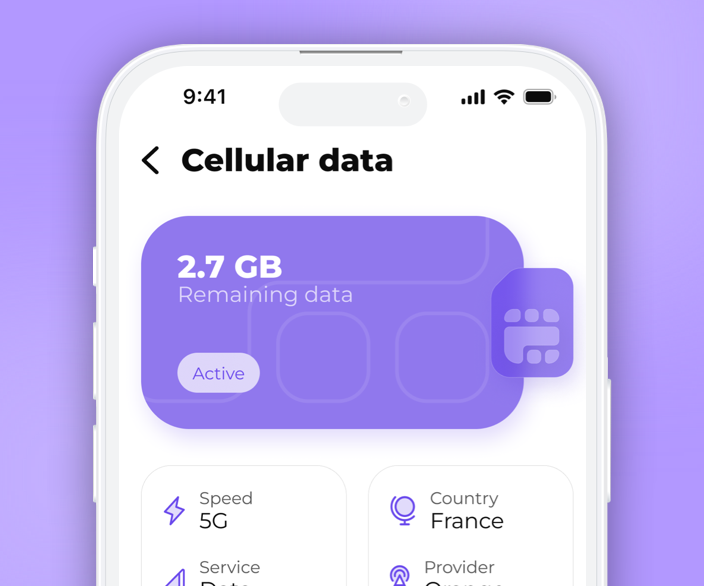
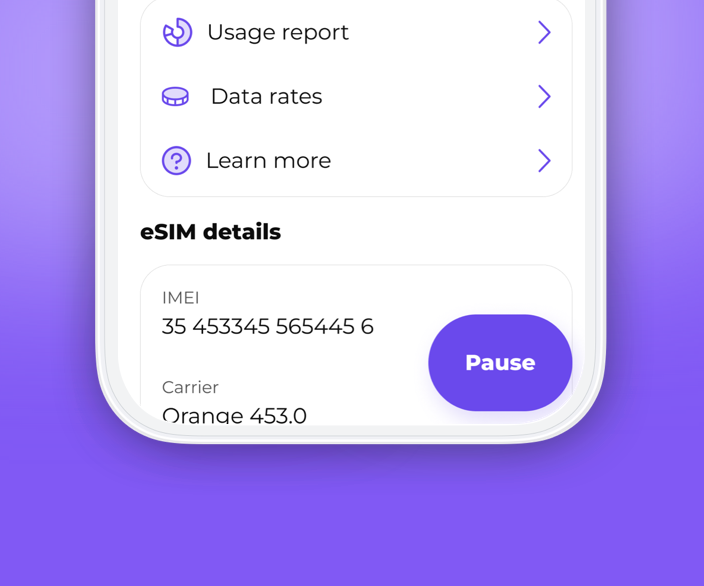
At a glance:
• Pay by the gigabyte: no day passes, no bundle you have to finish before the flight home.
• Post-Brexit proof: Britain sits outside EU roaming rules, so an EU SIM can bill the UK as an extra zone — this eSIM does not care.
• Three networks, one profile: EE, Vodafone UK and O2 are picked automatically, city or coast path.
• Installed before you fly: scan the QR at home and switch it on when the wheels touch down.
• Credits keep: whatever you do not use in Britain travels with you to the next country.
Here is the number that should shape your budget: more than 99% of people in the UK live inside 4G coverage, according to Ofcom. Your home carrier's roaming add-on covers exactly that same ground — and charges you for every day you are away, whether you stream a season of something or just check a train time. A pay-as-you-go eSIM flips the deal. You buy data for the United Kingdom by the gigabyte, spend it over two weeks or two months, and keep whatever is left for the next country on your route.
Which networks you will be on, and how fast they are
Three networks carry the profile: EE (BT Group), Vodafone UK and O2 (Virgin Media O2). Your phone tests them and locks onto the strongest one wherever you happen to be — a hostel in Shoreditch, a station platform in Glasgow, a bus shelter on the way to a trailhead. You never open a menu or type an operator name.
Speeds, honestly: Opensignal's United Kingdom Mobile Network Experience reporting has users in London, Manchester, Birmingham, Edinburgh and Glasgow on 5G for over 31% of their connected time, averaging more than 230 Mbps when they are. Away from the big five, Ofcom puts 4G within reach of over 99% of the population, typically 50 to 105 Mbps in towns and suburbs. That is plenty for maps, booking sites and a video call from a hostel kitchen.
Leaving Britain mid-trip: the United Kingdom rate applies while you are on a British network. Cross to Ireland, take the Eurotunnel into France or ferry out to the Channel Islands and billing shifts to that country's per-GB rate, each one listed on the SLYNUMBER destinations page. Since Brexit took the UK out of the EU's roam-like-at-home arrangement, that clean handover is worth real money — no zone surcharges, no second eSIM to buy, and your credit balance carries straight over.
Will your phone take it? The profile installs on iPhone XS and later, Google Pixel 3 and later, Samsung Galaxy S20 and later if the handset is carrier-unlocked, plus most eSIM-capable tablets. Check in thirty seconds before you buy: open Settings → Cellular → Add eSIM and look for the option.
1. Why pay-as-you-go beats the alternatives in Britain
Four ways travellers get data here, and why the eSIM is the one that leaves money in your pocket.
A daily fee punishes long trips
Roaming add-ons charge for time, so a three-week trip costs three weeks whether you use 200 MB or 20 GB. Buying gigabytes flips that around: the rate is fixed, and a frugal traveller pays frugal money. Nothing renews behind your back either, which means no surprise line on the statement you read six weeks after landing.
No queue, no passport, no plastic
Airport SIM counters want ID, a wait and usually a bundle sized for someone else's holiday. The eSIM is already on your phone before the plane doors open, so your first move in Britain is finding the right bus, not the right kiosk. Keep your home SIM in the tray for calls and let the eSIM handle data.
Something reliable between hostels
Hostel Wi-Fi is fine at midnight and useless at check-in time, when forty people share it. With your own data you can pull up a booking confirmation on the doorstep, find the night bus after the pub closes, and video-call home from a bunk without begging for the router password.
One profile for the whole route
The same eSIM works in 120+ countries and the number itself rings in over 150, so Britain can be the first leg or the last. Add Dublin, Amsterdam or a flight south and nothing needs reinstalling — the per-GB rate changes, the setup does not. Cheaper than a fresh SIM in every capital, and far less faff.
2. Data for the way you will actually move around Britain
Trains, coaches, cities and hills. Four travel patterns, and what to expect from your signal in each.
Booking on the move
Half of budget rail travel in Britain is timing: advance fares, split tickets, and a live app telling you which platform changed. All of that needs data at the exact moment you are standing in a concourse. Coverage on main lines is strong, King's Cross to Waverley included, so you can book the next leg from your seat instead of paying walk-up prices at a machine.
Long hauls for very little money
Coaches follow the motorways, which is where masts cluster, so the M1 north or the M4 west stays connected for most of the ride. Six hours on a coach becomes tolerable with a podcast queue, and you can watch your arrival time slide in real time and message the hostel about a late check-in before they lock the desk for the night.
London, Manchester, Birmingham, Glasgow
The five biggest cities are where 5G actually shows up, and where you will use data hardest — contactless travel apps, walking directions between free museums, a dozen photos uploaded from Camden Market. Deep Tube tunnels remain patchy in places, so screenshot the line map. Above ground, expect a fast connection from breakfast in the Northern Quarter to last orders in Soho.
Where the signal actually thins
Britain runs out of bars in the good places: glens in the Scottish Highlands, the middle of Eryri, ridge paths in the Lake District, stretches of the Cornish coast. Download your route and any offline maps in the last town with a supermarket. Signal usually returns at the car park or the village pub, which is exactly where you need to check the last bus.
3. Three steps, all done before you leave home
Five minutes on your own Wi-Fi now saves you an hour of airport faff later. Work through it the night before you fly.
Grab the app,
buy UK data
Install SLYNUMBER from the App Store or Google Play, create an account and choose the United Kingdom. A one-time $5 activation fee applies to your first eSIM; after that you are only paying the United Kingdom per-GB rate on data you actually use.
Scan the QR
at home
Install the profile while you are still on trusted Wi-Fi. Scan the code the app shows you, or type in the details if you prefer. The line stays off and unbilled until you want it, so there is no penalty for setting up a week early.
Land, switch on,
you are online
Flip the SLYNUMBER line on in your settings when you get off the plane. It registers on EE, Vodafone UK or O2 by itself and keeps choosing the strongest of the three as you move from London to the Highlands.
4. Which apps eat your gigabytes in Britain
Four apps do most of the damage on a trip like this. Here is roughly what each one costs you in data.
Group chats, hostels and calls home
Your usual number stays live on eSIM data, so nobody has to save a new one halfway through your trip. Sort out meeting points in a group chat while you are stuck at Euston, send voice notes from the top deck of a bus in Edinburgh, ring your parents from a bunk in Bristol so they stop worrying. Voice calls cost roughly 5 MB a minute, which puts a fortnight of daily chats around 300 MB. Photos are heavier: twenty pictures of the Highlands sent to the family group is maybe 40 MB. Hostel Wi-Fi collapses at check-in when everyone piles on at once, and that is exactly when your own data keeps the call standing.
Posting from Camden to Arthur's Seat
The good backdrops here are free, which suits the budget nicely. Stories from Borough Market on a Saturday, a Reel climbing Arthur's Seat at sunrise, a carousel of street art down Brick Lane. Reckon on about 70 MB for a 60-second Reel at 1080p and 3 to 5 MB per Story, so a heavy posting day lands near 150 MB. Uploads fly in the five big cities where 5G is common and slow politely in a Yorkshire village. Instagram holds anything it cannot send yet, so a dead spot inside the British Museum only delays the post, and free museum entry means you will have plenty to post.
Clips from festivals and long train windows
Britain hands you material for nothing: Notting Hill Carnival in late August, the Edinburgh Fringe filling the same month with street performers, the West Highland Line rolling past Rannoch Moor outside your window. A 60-second clip uploaded at 1080p costs around 80 MB, less if you drop the resolution before posting. Big crowds are where automatic network switching earns its keep, because one operator's cell gets swamped while another still answers. If you film for a week and upload nightly, plan on 1 to 2 GB for TikTok alone, and keep an eye on the balance in the app before you hit publish.
Getting between stations, trailheads and beds
This is the app your trip genuinely depends on. Live directions between a coach station and a hostel, bus times in Birmingham, the walking route from Waverley up to the Royal Mile with your pack still on. Google Maps also knows which train platform you want, which saves running. Download the offline map before you fly — the whole United Kingdom region is under 700 MB, so grab it on home Wi-Fi rather than paying for it — and keep it for the Highlands, mid-Wales and the deeper Lake District valleys. When the signal comes back, live navigation picks up again and your arrival time corrects itself.
Best eSIM for the United Kingdom
Prefer to watch someone do it first? The clip below runs through the whole thing, start to finish, in a couple of minutes.
A short walkthrough of buying United Kingdom data in the SLYNUMBER app, installing the eSIM by QR code before departure, and getting online on a British network the moment you land.
6. Burner apps, spare SIMs and SLYNUMBER, side by side
Every hostel common room produces the same advice: use a free burner number, pick up a cheap second SIM, or dust off an old VoIP account. All three are cheaper than they look until a verification code fails to arrive. The table below puts them next to a real U.S. mobile number with pay-as-you-go eSIM data, so you can see which corners each option cuts.
| Feature |
SLYNUMBER |
Google Voice |
Burner Apps |
Carrier 2nd line |
| Real U.S. mobile number | Yes | No | Varies | No |
|---|
| SMS verification for apps | Yes | Limited | Often blocked | Yes |
|---|
| Immune to SIM swapping | Yes | Yes | Yes | No |
|---|
| Custom voicemail | Yes | Yes | Rarely | Yes |
|---|
| International calling | Yes | Limited | Rarely | Carrier dependent |
|---|
| eSIM / Data plans | Yes | No | No | Carrier dependent |
|---|
| Number permanence | Permanent | Permanent | Temporary | Permanent |
|---|
| Requires carrier number | No | Yes | Varies | Yes |
|---|
| Starting price | $14.99 / 3 months | Free | $2–$5/week | $10–$15 add-on |
|---|
7. What you get and what it costs
In the box
Everything the account includes:
- A real U.S. mobile number, not a VoIP line, so verification actually goes through
- Calls, texts and picture messages sent and received in the app over any connection
- Pay-as-you-go eSIM data in 120+ countries from the one profile you installed
- A number that stays reachable in more than 150 countries
- Automatic switching between EE, Vodafone UK and O2 while you are in Britain
- Credits with no expiry date, so nothing is wasted between trips
- No contract, no minimum term, nothing to cancel when you get home
Because it is a genuine U.S. mobile line, WhatsApp, Telegram, PayPal, Venmo, Instagram, Snapchat, Amazon and Gmail all take it for signup and verification. Codes arrive exactly as they would on a phone back home, which matters when a hostel platform or a bank app decides to check who you are at eleven at night.
Security
Calls and messages are encrypted in transit with TLS and SRTP. Keeping the number in your account rather than on a SIM card also removes the usual SIM-swap trick, and it means a phone lost in a dorm does not take your number with it.
The prices
Two ways to pay for the number, plus credits and data as you go:
- $4.99 a month on the quarterly cycle — one charge of $14.99 every three months
- $49.99 for a full year if you would rather pay once and forget it
- $10 for 1,000 credits, where one credit buys a minute of talk, one text or one picture message — data is billed separately at the United Kingdom per-GB rate, after a one-time $5 eSIM activation fee
The app
SLYNUMBER is on the App Store and Google Play, and the app is where you buy data, top up credits, watch your usage and change plans. SlyAI, the assistant built into it, sorts out setup and billing questions on the spot — useful when you are asking at two in the morning from a night bus.
8. Questions from the hostel common room
It does. LNER and Avanti West Coast services on the 650 km London to Edinburgh run take about 4 hours 20 minutes, and the line follows corridors covered by EE, Vodafone UK and O2 the whole way. Expect 5G around King's Cross and Waverley and solid 4G in between, dropping only in the Severn Tunnel and a few cuttings through the Cumbrian fells. Coaches are the same story, since they follow the motorways. Queue a playlist before you board and you will not notice the gaps.
The profile follows you. Land in Dublin, ride the Eurotunnel to Calais or sail to the Channel Islands and the eSIM picks up a local partner network in a minute or two, then bills at that country's own per-GB rate, which you can look up on the SLYNUMBER destinations page. This matters more than it used to: Britain sits outside the EU roaming rules now, so an EU SIM will often treat the UK as an extra-cost zone and vice versa. Your credits do not care about borders, and they never expire.
Budget 6 to 8 GB for a fortnight. Hostel Wi-Fi will carry your evenings, so most of your data goes on the road: maps between stations, train times, booking the next bunk, a podcast on the coach. That runs 300 to 500 MB a day. If you post daily and video-call home twice a week, add another 2 GB across the trip. Start with 5 GB, watch the counter in the app, and top up when you see it dropping.
It is a real U.S. mobile number that lives in an app instead of on a bit of plastic. Calls, texts and picture messages ride over whatever data you have, so it rings on hostel Wi-Fi in Glasgow the same way it rings on cellular in Soho. And because it is a genuine mobile number rather than a VoIP one, sites that reject internet numbers accept it without argument.
Because free numbers are shared numbers. They get recycled, blocklisted, and rejected the moment you try to verify a bank, a hostel booking site or a marketplace account. Your SLYNUMBER line belongs to you for the life of the plan, which is what you want when a code has to reach you six months from now. Cheap is only cheap if the number still works when you need it to.
Pick a cycle: $4.99 a month billed quarterly, which comes to $14.99 every three months, or $49.99 once for a whole year. Talking and texting run on credits, and $10 tops you up with 1,000 of them, one credit per minute of talk, per text or per picture message. They never expire. Data is separate, charged at each country's per-GB rate, and your very first eSIM carries a one-time $5 activation fee.
For SIM-swap fraud, yes. That scam works by talking a shop or call centre into moving your number onto a fresh card, and there is no card here to move. The line sits behind your account login, with calls and messages encrypted using TLS and SRTP. Losing a phone in a hostel dorm also stops being a crisis: log in on another device and your number comes with you.
They will. WhatsApp, Telegram, PayPal, Venmo, Instagram, Snapchat, Amazon and Gmail all accept the number, and one-time codes turn up in the app seconds after you request them. All you need is a live connection, whether that is your eSIM data on a train or the free Wi-Fi in a Manchester coffee shop. Travellers keep the same number across several trips without re-verifying anything.
Yes, and that is half the value. The number reaches you in more than 150 countries, and the eSIM side covers 120+, so the line you used to book hostels in Edinburgh is the same one you use in Lisbon or Bangkok next spring. Nothing to reinstall, no local SIM to hunt down at an airport kiosk. It is simply your number now.