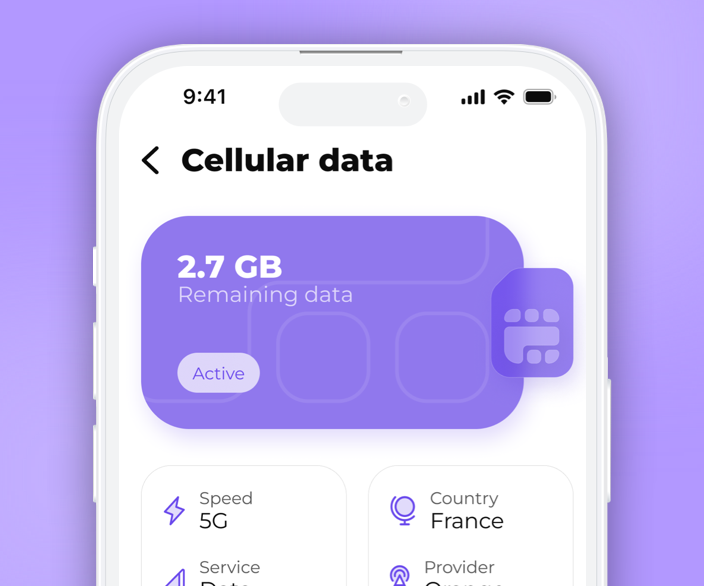
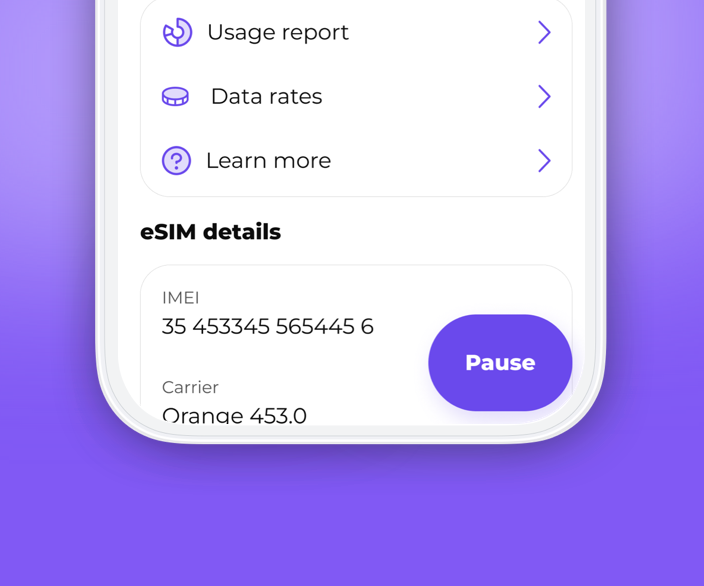
Quick Facts:
• Outside-EU insurance: Switzerland isn't covered by EU roaming bundles — SLYNUMBER bills plain pay-as-you-go data instead, with no contracts.
• Three host networks: the eSIM auto-selects the strongest of Swisscom, Sunrise, and Salt, from Zürich to Lausanne.
• Provisioned before takeoff: install by QR code at home; switch it on when the wheels touch down.
• Reachable everywhere: your existing WhatsApp number keeps working, so check-ins home never depend on hotel Wi-Fi.
• One app for control: live usage tracking, top-ups, and the SlyAI assistant travel in your pocket.
Here's the mistake: travelers activate an EU roaming bundle in Paris or Munich, cross into Switzerland, and discover at the top of their first cable car that Switzerland was never included. The bill arrives later. As a country outside the EU, Switzerland is where roaming assumptions go to die — and where a pay-as-you-go eSIM earns its keep. SLYNUMBER connects you to Swisscom, Sunrise, and Salt at a flat per-GB rate, with no contract and nothing hiding in the fine print. You stay reachable; your budget stays intact.
Swiss networks & real-world coverage
Your eSIM rides on three host networks in Switzerland: Swisscom, Sunrise, and Salt Mobile. The handset measures signal continuously and camps on whichever is strongest — you never pick manually. One less thing to manage.
How fast is it really? Opensignal's Switzerland measurements show users in Zürich, Geneva, Basel, Bern, and Lausanne on 5G for over 38% of their connected time, averaging beyond 290 Mbps. The regulator BAKOM/OFCOM puts 4G/LTE reach above 99% of the population, with suburban speeds typically 65–125 Mbps.
Leaving the country? The Switzerland per-GB rate applies while you're on a Swiss network. Step across into France, Germany, or Italy and billing simply switches to that country's own rate — every one of them listed on the SLYNUMBER destinations page. Same eSIM, same credits, zero reconfiguration.
Will your phone take it? The eSIM runs on iPhone XS and newer, Google Pixel 3 and newer, Samsung Galaxy S20 and newer (carrier-unlocked), plus most eSIM-capable tablets. Check in ten seconds: Settings → Cellular → Add eSIM.
1. Why solo travelers carry this eSIM into Switzerland
Traveling alone means being your own backup plan. Each of these four covers a failure point before it happens.
A per-GB rate instead of a gamble
Roaming in a non-EU country is where phone bills go feral: a day of maps and messages on a home-carrier plan can cost more than a night in a hostel. SLYNUMBER meters data at the published Switzerland per-GB rate and shows your running total in the app, so the number you budgeted is the number you pay. No daily passes to remember to cancel. No fine print.
Land connected, not scrambling for Wi-Fi
The riskiest hours of a solo trip are the first ones — new city, heavy bag, no local knowledge. With the eSIM installed at home, your phone registers on a Swiss network while you're still on the jet bridge. Family sees your check-in, your accommodation gets your message, and the route to the hotel is live in your hand.
Three networks are your redundancy
Safety-first travel is really about redundancy. Because the eSIM can attach to Swisscom, Sunrise, or Salt, one carrier's dead zone rarely means your dead zone — the phone quietly re-camps on the strongest alternative. Add offline maps for the high valleys and you have layered fallbacks, the way a good hiker carries layers.
One profile for the whole journey
Solo itineraries mutate. If a hostel friend talks you into a Milan detour or a Black Forest weekend, the same eSIM follows you into Italy, Germany, France, and 120+ destinations in total, billing each at its own listed rate. You never shop for a new SIM mid-trip, and your credits never expire — so a change of plans wastes nothing.
2. Data that follows a solo route through Switzerland
Four shapes a solo Swiss trip usually takes — and what your connection is doing in each one.
Zürich, Bern, Basel by train
The classic first-timer loop is stitched together by SBB. Onboard, coverage holds along the mainlines, so you can confirm the next hostel, catch up on messages, and stream between stops. In the cities themselves, 5G is dense: Zürich's Niederdorf lanes, the arcades of Bern's old town, Basel's Rhine banks — all comfortably live for maps, translations, and museum tickets bought in the queue.
Geneva and Lausanne at walking pace
Along Lake Geneva the eSIM does quieter work: live boat timetables between Lausanne and the Évian-bound piers, restaurant lookups in Geneva's old town, a video call home from the lakeside promenade with the Jet d'Eau behind you. Coverage on the shoreline routes is strong on all three networks, and the app's usage meter keeps a lake-day's browsing honest.
Zermatt, Interlaken, and the high routes
This is where the safety habit matters. Signal reaches remarkably far up — the Jungfraujoch and Zermatt's trails are well covered — but high traverses still hide dead pockets. The rule: share your route with someone before you start, download the offline map, then enjoy the fact that live data works at most viewpoints for check-ins and weather. Connectivity is a tool; redundancy is the plan.
Basel triangles and Geneva's edges
Basel touches France and Germany; Geneva is nearly surrounded by France. Wander across for lunch and your phone may register a foreign network — with SLYNUMBER that's not an incident, just a rate change to that country's per-GB price. Watch the network name in your status bar if you're keeping a strict budget, or simply let it happen: same profile, same app, no action needed.
3. Ready before departure, in three moves
Do this from your sofa, not the arrivals hall. Total time: a few minutes.
Get the app,
choose a plan
Install SLYNUMBER from the App Store or Google Play and pick the plan that fits. The one-time $5 eSIM activation fee happens here; data credits are bought separately and never expire.
Install the eSIM
while still at home
Scan the QR code from the app, or enter the details manually. Doing it on home Wi-Fi means the fiddly part is finished before the trip begins.
Switch on,
connect on arrival
Enable the eSIM in settings when you land. It finds Swisscom, Sunrise, or Salt on its own and locks to the strongest signal — you do nothing.
4. Your everyday apps, on Swiss signal
The apps you already use are also your safety kit. Here's how each behaves on SLYNUMBER data in Switzerland.
Check-ins that always go through
For a solo traveler, WhatsApp is the check-in system, and it keeps your existing number without any SIM juggling. Set a rhythm — a morning message before you set off, a pin drop when you reach the day's destination — and it costs almost nothing: voice calls use about 3–8 MB per minute, so even nightly calls home rarely pass 500 MB in a week. Share your live location with a friend while you cross Bern's old town after dark, or video-call from a Lausanne café without hunting for Wi-Fi. Because the eSIM keeps its own data lane, your safety net doesn't depend on a hostel router. That reliability is the whole point.
Summit posts without summit Wi-Fi
The Matterhorn does not wait for a good connection, but you'll usually have one anyway: 4G reaches most classic viewpoints, from Zermatt's trails to the Jungfraujoch terraces. A 60-second Reel uploads for roughly 50–80 MB, and Stories from the Chapel Bridge in Lucerne or the vineyards above Lake Geneva go out in seconds on city 5G. One habit worth keeping: post while you're still at the viewpoint, because the upload doubles as a timestamped signal to the people following your trip that you're exactly where you should be. Instagram's auto-save keeps drafts intact if a gondola briefly drops the connection.
Filming solo, uploading on the spot
Switzerland hands a solo creator easy material: the Glacier Express window view, a dawn walk through Zürich's Niederdorf, cowbells above Grindelwald. Uploads of a standard 60-second clip run 30–100 MB depending on resolution, well within a normal day's budget at the Switzerland per-GB rate. In crushes like the Zürich Street Parade in August or Montreux Jazz in July, the eSIM's habit of re-camping onto the strongest of Swisscom, Sunrise, or Salt keeps uploads moving while single-network phones stall. Watch your running usage in the SLYNUMBER app between takes; scrolling the feed burns data faster than filming ever will.
Navigation with a fallback layer
Treat navigation as two layers. The live layer: Google Maps on eSIM data handles SBB connections, tram routing in Basel and Zürich, and last-minute restaurant hunts near Genève-Cornavin, with solid 4G along the A1 corridor and most rail lines. The fallback layer: before any mountain day, download the offline region — all of Switzerland fits in under 320 MB — because gorges and high passes in the Bernese Oberland or Engadin can still go quiet. When signal returns, live traffic and timings resume by themselves. A solo traveler running both layers never truly navigates blind, and that is exactly the standard to hold.
Best eSIM for Switzerland
Prefer to see the setup end to end? The short video below walks through install and activation — worth two minutes before your flight.
Video guide: installing SLYNUMBER's Switzerland eSIM, from QR scan to a live connection on Swiss networks.
6. How this stacks up against other privacy tools
A traveler protecting their number and their data budget has options — burner apps, spare SIMs, VoIP lines. The table below sets them side by side with SLYNUMBER's pairing of a real U.S. mobile number and metered eSIM data, so you can judge on facts rather than marketing.
| Feature |
SLYNUMBER |
Google Voice |
Burner Apps |
Carrier 2nd line |
| Real U.S. mobile number | Yes | No | Varies | No |
|---|
| SMS verification for apps | Yes | Limited | Often blocked | Yes |
|---|
| Immune to SIM swapping | Yes | Yes | Yes | No |
|---|
| Custom voicemail | Yes | Yes | Rarely | Yes |
|---|
| International calling | Yes | Limited | Rarely | Carrier dependent |
|---|
| eSIM / Data plans | Yes | No | No | Carrier dependent |
|---|
| Number permanence | Permanent | Permanent | Temporary | Permanent |
|---|
| Requires carrier number | No | Yes | Varies | Yes |
|---|
| Starting price | $14.99 / 3 months | Free | $2–$5/week | $10–$15 add-on |
|---|
7. Features and pricing, without the fog
What's in the box
Every subscription carries the full kit — there is no premium tier hiding the good parts:
- A genuine U.S. mobile number that verification systems don't flag as VoIP
- Works in 150+ countries; companion eSIM data reaches 120+
- Metered data billed at each destination's published per-GB rate
- Credits that never expire — buy once, spend across any number of trips
- Host networks chosen automatically by signal strength, in Switzerland and beyond
- SlyAI, the in-app assistant, for setup help at any hour
- Usage meters, top-ups, and plan management inside one app
WhatsApp, Telegram, PayPal, Venmo, Instagram, Snapchat, Amazon, and Gmail all accept the number for signups and verification codes — it behaves exactly like a domestic U.S. line because, technically, it is one.
Security posture
Calls and messages are protected with TLS and SRTP encryption in transit. With no physical SIM to steal and no carrier desk to social-engineer, the classic SIM-swap route into your accounts is closed off.
The price list
Three figures cover everything:
- Quarterly cycle: $4.99/month, collected as $14.99 every three months
- Annual: $49.99 for the year
- Credits: $10 per 1,000 — a credit is one call minute, one SMS, or one MMS
App & devices
Available on the App Store and Google Play with SlyAI built in. eSIM support covers iPhone XS and newer, Google Pixel 3 and newer, Samsung Galaxy S20 and newer (carrier-unlocked), and most eSIM-capable tablets — confirm under Settings → Cellular → Add eSIM.
8. Switzerland eSIM: the questions solo travelers ask
Mostly, yes. The Zürich–Geneva mainline runs through corridors where Swisscom, Sunrise, and Salt all maintain solid 4G, and your eSIM hops to whichever of the three is strongest at any moment. Expect roughly 2 hours 45 minutes of usable connectivity, with 5G appearing around Zürich HB and Genève-Cornavin. The exceptions are long Alpine tunnels — the Gotthard Base Tunnel included — where every network fades. Treat those gaps as planned downtime: queue playlists and offline maps before boarding, and the trip continues uninterrupted.
No. Switzerland sits outside the EU, which is exactly why so many travelers get stung by roaming here — but SLYNUMBER treats it as just another covered country. Cross into France, Germany, Italy, Austria, or Liechtenstein and the eSIM re-registers on a local host network within about a minute, billing at that country's own per-GB rate from the destinations list. No profile swaps, no APN edits, no second QR code. Your credits travel with you and never expire.
Plan around 3–5 GB for seven days split between Zürich, Bern, and a mountain base like Interlaken. Daily check-in calls home, navigation, and messaging stay under 2 GB for the week. Add photo uploads, story posts from the Jungfraujoch, and music on trains and you land nearer 4 GB. Hotspotting a laptop or streaming HD video pushes budgets to 8–10 GB. Since billing is pay-as-you-go at the Switzerland per-GB rate, overestimating costs nothing — unused credits simply wait for the next trip.
It's a real U.S. mobile number that lives in the SLYNUMBER app instead of on a physical SIM. Because it isn't flagged as VoIP, services that reject internet-phone numbers — WhatsApp, PayPal, Venmo, Instagram, Amazon, Gmail — treat it like any domestic line. For a solo traveler, that means one stable, private number for bookings and verifications that works on any network your eSIM uses. Calls, SMS, and MMS run on credits: $10 buys 1,000, and one credit covers a minute, a text, or a picture message.
Burner apps hand out recycled VoIP numbers, and platforms have learned to spot them — verification codes bounce, accounts get flagged, and the number may be retired without warning. SLYNUMBER issues genuine U.S. mobile numbers, so 2FA texts from banks and booking sites arrive reliably. The number stays yours for as long as you keep the plan, which matters when your hotel, your airline, and your family all have it saved. A burner is designed to be thrown away. This is designed to be kept.
Three numbers to remember. The subscription is $4.99 a month on the quarterly cycle, billed as $14.99 every three months, or $49.99 for a full year. Calling and texting credits are $10 per 1,000 — one credit equals a one-minute call, an SMS, or an MMS — and they never expire. eSIM data is separate, pay-as-you-go at each country's per-GB rate, with a one-time $5 activation fee when you install the eSIM. No contracts, no roaming surcharges, no surprise line items.
It removes the attack's easiest entry point. Classic SIM-swap fraud works by convincing a carrier's support desk to port your number to a criminal's SIM card. A SLYNUMBER number has no physical SIM to port and no retail support desk to social-engineer — access is tied to your authenticated app login, and traffic is protected with TLS and SRTP encryption. For a traveler alone in another country, keeping the number that guards your bank logins out of reach is a quiet but real safety upgrade.
Yes — that's one of its main jobs. Because the number is a real U.S. mobile line, verification SMS from banks, card issuers, airlines, and platforms like PayPal, Amazon, and Gmail are delivered normally rather than silently blocked as VoIP. The codes arrive in the SLYNUMBER app over any data connection: your Swiss eSIM data, hotel Wi-Fi, or a café hotspot. So when your card gets a fraud check the night before a mountain excursion, you clear it in seconds instead of losing a day.
It works anywhere your phone has an internet connection, in 150+ countries. The number lives in the cloud, not on a local SIM, so calls and texts route through the app whether you're on Swisscom in Zermatt, hotel Wi-Fi in Lausanne, or a completely different network two borders away. People dialing you notice nothing — it rings like a normal U.S. mobile. Pair it with SLYNUMBER's eSIM data, which covers 120+ countries, and you carry both the pipe and the number in a single app.