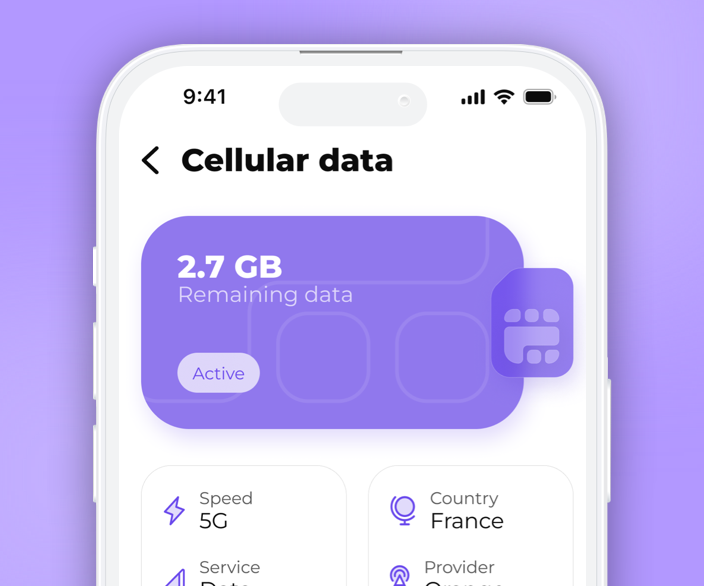
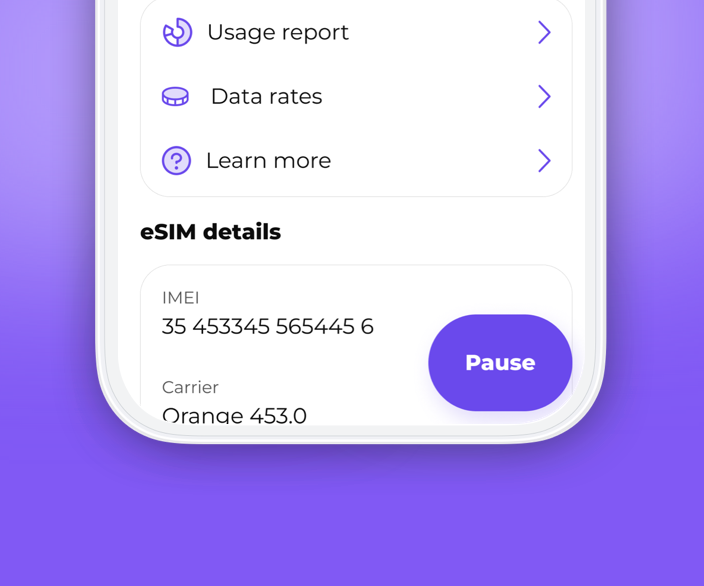
Quick Facts:
• Contract-free data: Pay-as-you-go gigabytes at the Norway per-GB rate — no subscription, no roaming charges, no exit fees.
• Three networks, one profile: The eSIM auto-selects Telenor Norway, Telia Norway, or Ice, covering Oslo, Bergen, Trondheim, Stavanger, and Drammen.
• Five-minute install: QR-code setup from home; enable it when the plane doors open.
• Border-proof: Sweden, Finland, and Denmark bill at their own listed rates on the same eSIM, and credits never expire in between.
• Run from the app: Usage graphs, top-ups, and plan changes without ever visiting a carrier store.
Here is the promise: dependable Norwegian data, no Norwegian paperwork. Cafés in Grünerløkka pour excellent coffee, but their Wi-Fi was never meant to hold your video calls, and signing a local contract with Telenor, Telia, or Ice makes little sense for a stay measured in weeks. SLYNUMBER's eSIM takes the third path — it rides all three of those networks on pay-as-you-go terms, installs before you fly, and bills by the gigabyte, so your connectivity scales with your workload instead of with a plan someone else designed.
Networks & Coverage in Norway
Your eSIM authenticates onto Norway's three principal host networks — Telenor Norway, Telia Norway, and Ice — and continuously prefers whichever delivers the strongest signal at your location. Manual carrier selection is never required; the switching is silent and automatic.
Speeds you can plan around: Opensignal's Norway Mobile Network Experience reporting measures users in Oslo, Bergen, Trondheim, Stavanger, and Drammen at over 36% of connected time on 5G, with average 5G downloads beyond 275 Mbps — comfortably above what a video call needs. The regulator Nkom (Norwegian Communications Authority) reports 4G/LTE reaching over 99% of the population, with suburban speeds generally in the 60–120 Mbps band.
Working across borders: the Norway per-GB rate applies while you are on a Norwegian network. Cross into Sweden, Finland, or Denmark (by ferry) and the same eSIM re-registers locally, billing at that country's rate — the full table lives on the SLYNUMBER destinations page. Credits carry over automatically; there is nothing to reconfigure.
Hardware requirements: iPhone XS and newer, Google Pixel 3 and newer, Samsung Galaxy S20 and newer (carrier-unlocked), plus most eSIM-capable tablets. Verify yours in ten seconds: Settings → Cellular → Add eSIM.
1. Why It Works for Working Travelers
Four properties of the service map directly onto how remote workers actually move through Norway.
Pay for the month you actually had
Some months you live in coworking spaces and barely touch cellular; others you hotspot a laptop from a cabin above the Sognefjord for two weeks straight. Per-gigabyte billing absorbs both without a plan change — and since credits never expire, an over-purchase in March is simply April's budget.
One known rate per country
Roaming bundles force you to predict usage before you know your schedule. SLYNUMBER replaces the guesswork with a single published per-GB rate for Norway, visible before purchase, identical whether you stay six days or six months. The app's live meter shows exactly where each gigabyte went.
Working before baggage claim
Install the eSIM by QR code from home, enable it when you land at Gardermoen or Flesland, and the first messages sync on the walk to the express train. No kiosk, no ID registration queue, no fiddling with a SIM tray at the airport café.
Cities, corridors, and most cabins
Oslo, Bergen, Trondheim, Stavanger, and Drammen are dense with signal, and the corridors between them — the E6, the coastal ferry stops, the main rail lines — hold 4G for the overwhelming majority of the route. Three host networks mean a dead zone needs all three to fail at once.
2. The Rest of the Toolkit
Data is one line item. These four are what make the setup feel like infrastructure rather than a travel hack.
Your identity does not travel
Your existing number and WhatsApp account remain exactly as they are; the eSIM only supplies data underneath them. Clients, group chats, and 2FA-dependent accounts see no change at all, whichever Norwegian network your phone happens to be riding.
The laptop comes online too
Hotspot from your phone whenever the room's Wi-Fi disappoints — a common event in mountain lodges and older Bergen guesthouses. A tethered video call consumes roughly a gigabyte per hour, which per-GB pricing turns into a knowable, budgetable cost instead of a surprise.
Usage, top-ups, and SlyAI
The SLYNUMBER app graphs consumption in real time, handles top-ups in under a minute, and includes the SlyAI assistant for account questions at 2 a.m. — useful when your workday runs on U.S. hours from a European time zone.
Norway is one stop, not the plan
When the season ends and you relocate, the same eSIM profile follows: coverage spans 120+ countries with each per-GB rate published upfront. Leftover credits from Norway spend identically in the next country — nothing resets, nothing expires.
3. Setup in Three Moves
The entire flow fits inside a coffee break, and none of it happens at an airport counter.
Download, register,
buy Norway data
Install the SLYNUMBER app from the App Store or Google Play, then purchase pay-as-you-go data for Norway. A one-time $5 activation fee is charged when the eSIM is created; data credits are bought separately and never expire.
Scan the QR code
while still at home
On solid Wi-Fi, scan the QR code the app displays — or add the profile manually through settings. One minute later the eSIM is installed and idle, ready to be switched on the day you fly.
Land, toggle on,
start working
Enable the eSIM on arrival and it locks onto Telenor Norway, Telia Norway, or Ice automatically, always favoring the strongest signal. From that moment, every café, train seat, and cabin is a candidate office.
4. Your Working Apps on Norwegian Data
Field notes for the four apps that do the heaviest lifting between Oslo and the Arctic Circle.
Client calls from anywhere with a mast
WhatsApp stays bound to your existing number — the eSIM never touches it — so client calls, standup huddles, and family check-ins continue uninterrupted from day one in Norway. Voice calls cost roughly 3–6 MB per minute of data, so even a heavy week of calls barely dents a gigabyte, and the quality over Norwegian 4G routinely beats what hostel Wi-Fi delivers at peak hours. Take a call while the airport express glides into Oslo S, walk a client through a deck from a bench in Frogner Park, or send voice notes from the Fløibanen queue in Bergen. Live location sharing earns its place too: when a coworking acquaintance says meet me in Grünerløkka, you just drop the pin.
The fjord content uploads itself
Norway will flood your camera roll whether you plan it or not, and cellular upload speed decides whether that content ships today or next week. On SLYNUMBER data, a 60-second Reel — say, the view from Pulpit Rock above the Lysefjord, or mirror-still water at Geiranger — uploads in roughly 60–80 MB, a rounding error against a month's budget. Stories from Vigeland Park or Bergen's Bryggen wharf post in seconds on city 5G. The practical nomad note: schedule bulk uploads for urban stretches, since remote fjord arms may sit on modest 4G, and let Instagram's draft queue hold anything the mountains delay. Your feed does not need to know you were offline between two tunnels.
Short video, long daylight
Summer Norway gives you twenty usable hours of light, which is a content pipeline if you treat it like one. Film the Flåm railway grinding down its valley, a POV lap of Mathallen food hall in Oslo, or midnight sun over a Lofoten beach, then push clips to TikTok directly from location — a standard upload runs about 35–95 MB depending on export quality. The eSIM's habit of re-selecting the strongest of Telenor, Telia, and Ice keeps uploads moving even when a festival crowd — Bergen International in May, St Olav in Trondheim in late July — saturates one network. Watch the app's data meter afterward: it turns each posted clip into a known cost, which is how a working creator should think.
Routing for a country shaped like a coastline
Norwegian logistics punish improvisation: ferries have final departures, mountain passes close, and the shortest line on the map is rarely the fastest road. Live Google Maps on cellular keeps T-bane transfers in Oslo accurate, tracks E6 conditions between Oslo and Trondheim, and folds ferry crossings into driving estimates on the western fjord routes. Before committing to the thin-coverage interior — Jotunheimen trailheads, upper Sognefjord arms — pull the offline map: all of Norway stores in roughly 500 MB, and a single region in far less. When signal returns, live rerouting resumes silently. For a worker on a schedule, that difference between reachable and lost is worth more than the data it costs.
Best eSIM for Norway
A few minutes of video covering the exact flow: purchase, QR install, first connection, and reading the usage dashboard.
A complete walkthrough of buying and activating SLYNUMBER's Norway eSIM, filmed from first tap to live signal.
6. Weighing the Privacy Alternatives
Nomads improvise number privacy with burner apps, dual SIMs, and voice-over-IP workarounds — each with a failure mode you usually discover at the worst time. Here is SLYNUMBER lined up against them, factor by factor.
| Feature |
SLYNUMBER |
Google Voice |
Burner Apps |
Carrier 2nd line |
| Real U.S. mobile number | Yes | No | Varies | No |
|---|
| SMS verification for apps | Yes | Limited | Often blocked | Yes |
|---|
| Immune to SIM swapping | Yes | Yes | Yes | No |
|---|
| Custom voicemail | Yes | Yes | Rarely | Yes |
|---|
| International calling | Yes | Limited | Rarely | Carrier dependent |
|---|
| eSIM / Data plans | Yes | No | No | Carrier dependent |
|---|
| Number permanence | Permanent | Permanent | Temporary | Permanent |
|---|
| Requires carrier number | No | Yes | Varies | Yes |
|---|
| Starting price | $14.99 / 3 months | Free | $2–$5/week | $10–$15 add-on |
|---|
7. Features & Pricing
What every account includes
One tier, flat and complete. The full feature set comes standard:
- Genuine U.S. mobile number — carrier-grade, never flagged as VoIP by verification systems
- Pay-as-you-go eSIM data in 120+ countries, Norway among them
- Number usable from 150+ countries — your fixed point while everything else moves
- Credits with no expiry: unused balances roll forward indefinitely
- SlyAI assistant inside the app for instant account help
- Live usage graphs, one-tap top-ups, and plan switching from the app
- Zero contracts and zero roaming fees, with cancellation at any time
The number clears verification on the platforms a remote worker depends on — WhatsApp, Telegram, PayPal, Venmo, Instagram, Snapchat, Amazon, and Gmail all deliver their codes to it without complaint.
Security
Every call and message is protected by TLS and SRTP encryption in transit — a meaningful layer when your workday routinely crosses coworking Wi-Fi and hotel networks you did not configure.
Pricing
The cost structure is deliberately boring — two billing cycles, one credit bundle, one activation fee:
- $4.99/month on the quarterly cycle, collected as $14.99 every three months
- $49.99/year on the annual cycle for the lowest overall cost
- $10 per 1,000 credits — a credit buys a one-minute call, an SMS, or an MMS
Where to get it
Download SLYNUMBER from the App Store or Google Play. Plans, eSIM installation, credit top-ups, and the SlyAI assistant all live in the one app — your entire telecom stack in a single icon.
8. Common Questions
Mostly, yes — with preparation. The Bergen Line covers roughly 496 km in about six and a half hours, and Telenor Norway, Telia Norway, and Ice serve most of the corridor, so email, chat, and file syncs work for long stretches; 5G shows up around Oslo S and Bergen station. The catch is the Hardangervidda plateau, where long tunnels cut the signal repeatedly. Schedule deep-focus work for that middle section, sync your files before departure, and treat the reconnection near Voss as your upload window.
It does, without any action from you. Drive the E6 over Svinesund into Sweden, fly Oslo–Helsinki, or take the ferry down to Denmark, and the eSIM registers on a supported local network as soon as one is in range. Billing switches from the Norway per-GB rate to the destination country's rate — every rate is published on the SLYNUMBER destinations page — while your credits, which never expire, follow you across the border. No new profile, no APN edits, no second eSIM to juggle.
It depends how much you trust café Wi-Fi. If coworking spaces and your rental's broadband carry the video calls, cellular becomes a glue layer — maps, messaging, emergency tethering — and 5–8 GB covers a month comfortably. If you routinely hotspot a laptop from cabins and train seats, video meetings alone can burn a gigabyte per hour, so heavy months land closer to 15–20 GB. Pay-as-you-go pricing makes either pattern workable: buy what the month actually needs, and whatever remains never expires.
A second phone number that lives in software. SLYNUMBER issues you a real U.S. mobile number — carrier-grade, not a VoIP line that platforms flag — and hosts it in the app, where it makes calls, sends SMS and MMS, and receives verification codes over any data connection. For a nomad it means one stable, permanent number for clients, banks, and sign-ups, completely decoupled from whichever country's SIM or eSIM happens to be feeding your phone data that month.
Because burner apps mostly resell VoIP numbers, and the platforms you actually need — banks, PayPal, WhatsApp — have become very good at detecting and rejecting them. A verification code that never arrives is a real problem when you are eleven time zones from your bank branch. SLYNUMBER numbers are genuine U.S. mobile lines, so they clear those checks; calls are wrapped in TLS and SRTP encryption; and your credits sit on the account permanently instead of expiring like a burner's monthly allowance.
Predictable numbers, which matters when you budget by the month. The number costs $4.99 monthly on the quarterly cycle — billed as $14.99 every three months — or $49.99 flat for a year. Communication runs on credits: $10 buys 1,000, and each credit equals a one-minute call, one SMS, or one MMS. The eSIM itself carries a one-time $5 activation fee, and data is a separate pay-as-you-go purchase at each country's per-GB rate. Credits never expire, so nothing you buy is wasted.
By removing the attack surface. SIM-swap fraud targets the carrier-store layer: an attacker persuades a rep to move your number onto their SIM, then drains every account that texts you codes. Your SLYNUMBER number has no store, no rep, and no physical SIM to transfer — it exists only inside your authenticated app session, behind TLS and SRTP encryption. For anyone whose income flows through online accounts, cutting that single point of failure is the cheapest security upgrade available.
That is arguably its core job. Because the number is a real U.S. mobile line, Gmail, PayPal, Venmo, Amazon, and banking apps deliver SMS codes to it without the silent failures VoIP numbers suffer. Codes land in the SLYNUMBER app over whatever internet you have — Norwegian cellular, coworking Wi-Fi, a ferry's connection — so logging into payroll from Tromsø works exactly like logging in from home. Keep your home SIM in a drawer; the codes no longer depend on it.
It is built for exactly that. The number is location-independent — usable from 150+ countries — and pairs with eSIM data coverage in 120+, so relocating from Oslo to Lisbon or Bangkok changes nothing about how clients reach you. Same number, same app, same credit balance. Long-term nomads treat it as the fixed point in a moving system: addresses change, SIMs change, but the number printed on your invoices and registered with your bank stays put for years.