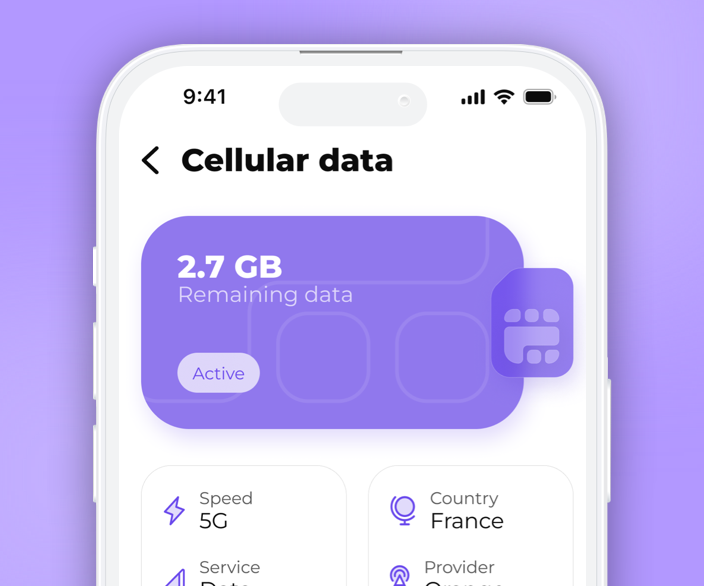
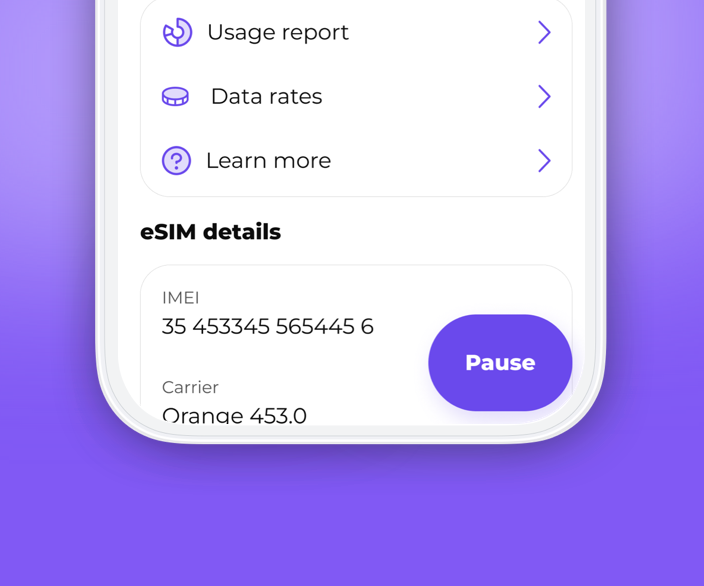
At a Glance:
• Pay-as-you-go: You're billed the France per-GB rate for the data you use — no bundles, no contracts, no roaming surprises.
• Rail-ready coverage: Orange, SFR, and Bouygues Telecom keep you connected from the Paris métro to the TGV corridors south.
• Set up before boarding: Install by QR code on any eSIM-capable iPhone or Android while you're still at home.
• WhatsApp untouched: Your existing number and chats carry on exactly as before — the eSIM only supplies data.
• One app for everything: Track usage, top up, and manage plans in the SLYNUMBER app, with credits that never expire.
The 08:11 TGV out of Gare de Lyon is at full speed before your coffee cools, Burgundy blurring into watercolor outside the window. Your phone should keep up. SLYNUMBER's France eSIM puts pay-as-you-go data on the country's three major networks from the moment you arrive — no roaming bill ambushing you at home, no queue at an airport SIM counter. Scan a QR code, and France is online.
Network and coverage in France
Who carries your signal: SLYNUMBER's France eSIM rides on Orange, SFR, and Bouygues Telecom. Your phone measures all three and attaches to the strongest — no manual network picking, on a station platform or anywhere else.
5G today: France switched on commercial 5G in late 2020 and has built it out quickly. Figures from the French telecom regulator ARCEP show 4G reaching close to the entire populated territory, with 5G live in Paris, Lyon, Marseille, Nice, Toulouse, Bordeaux, and a lengthening list of mid-sized cities. In practice: fast 5G downtown, dependable 4G/LTE nearly everywhere people live.
Crossing borders: The France rate applies while you're on a French network. Roll into Belgium, Spain, Italy, Switzerland, or Germany and billing switches to that country's rate automatically — every rate is listed on the SLYNUMBER destinations page. Credits carry over; settings stay untouched.
Will your phone work? The eSIM supports iPhone XS and newer, Google Pixel 3 and newer, Samsung Galaxy S20 and newer (carrier-unlocked), plus most eSIM-capable tablets. Check in ten seconds: Settings → Cellular → Add eSIM.
1. Why travelers switch to eSIM in France
Roaming add-ons and airport SIM counters both solve yesterday's problem. Here's what the pay-as-you-go approach changes.
Data priced like a carnet, not a contract
French transit taught the world the carnet: buy the rides you need, use them when you like. SLYNUMBER prices data the same way. You pay the France per-GB rate for what you consume — there's no monthly bundle to size, no expiry date racing you through it, no penalty for a quiet week. Heavy days and light days average themselves out. And whatever you don't use simply stays in your balance for the next border or the next trip.
Your home plan stays home
Roaming bundles from home carriers have a habit of expiring mid-trip or throttling right when the museum queue gets long. The eSIM sidesteps the whole arrangement: you connect to French networks as a local device, billed transparently per gigabyte. No surprise line items in next month's bill. Your home SIM can stay active for calls if you like — the SLYNUMBER eSIM handles the data lane on its own.
Installed before you've packed
The eSIM arrives as a QR code in the app the moment you buy. Scan it at home on Wi-Fi, and the profile sits dormant until you switch it on in France. Nothing to collect, nothing to ship, no kiosk French required at midnight. Most travelers finish setup in about two minutes. The one-time $5 activation fee at checkout is the only extra — after that it's just data at the per-GB rate.
One profile, the whole journey
A France trip rarely stays a France trip — a Brussels weekend here, a Barcelona detour there. The same SLYNUMBER eSIM works in 120+ countries, reattaching to local host networks as you cross each border and billing each country at its own listed rate. You install once. Every trip after this one starts already connected, which is a quietly wonderful way to travel.
2. Data that keeps up with your French itinerary
Every trip through France leans on connectivity differently. Four common shapes, and how the eSIM behaves in each.
Connected at 300 km/h
The TGV network is France's superpower — Paris to Lyon in two hours, Marseille in three, Bordeaux in just over two. Along those high-speed corridors your eSIM shuffles between Orange, SFR, and Bouygues Telecom to hold a working connection at full speed. Expect brief silences in tunnels and the odd rural valley. On slower TER regional trains, coverage tracks the towns the line strings together. Download tonight's episode before boarding and the gaps become invisible.
From métro platform to museum queue
City data is the easy case — Paris, Lyon, Marseille, Nice, and Bordeaux are dense with all three networks, and much of the Paris métro now has coverage on platforms and in tunnels. Look up the Sainte-Chapelle queue while you're still in bed. Navigate Le Marais by GPS instead of instinct. Split a dinner bill by app in a Lyon bouchon. The city runs on small data moments, and each one just works.
Provence, Normandy, and points between
The best of France is often an hour past the terminus — the lavender plateaus of Valensole, Normandy's D-Day beaches, the châteaux strung along the Loire. Villages and departmental roads hold usable 4G in the vast majority of cases; ARCEP puts 4G near the whole populated territory. Deep gorges and alpine passes are the honest exceptions. Save an offline map before you drive into the Verdon, and your eSIM handles the rest of the day fine.
Borders without homework
France touches Belgium, Spain, Italy, Switzerland, and Germany, and the eSIM treats each crossing as a non-event. Your phone finds a local host network within moments; billing flips to the new country's per-GB rate, published on the destinations page. Nothing to install, nothing to cancel afterwards. A Strasbourg-to-Basel day trip or a night train to Milan needs exactly zero connectivity planning — the same balance funds all of it.
3. From download to connected in three stops
Setting up takes about as long as validating a métro ticket. Do the first two steps at home; save the third for arrival.
Download the app,
pick your France plan
Get SLYNUMBER from the App Store or Google Play and choose a France data plan. Checkout includes the one-time $5 eSIM activation fee; after that, data is billed at the per-GB rate.
Scan the QR,
install before departure
On home Wi-Fi, scan the QR code from the app or add the profile manually. The eSIM installs in about two minutes and waits quietly until France.
Arrive, switch on,
connect
Enable the eSIM in settings when you land. Your phone attaches automatically to Orange, SFR, or Bouygues Telecom — whichever signal is strongest right there.
4. Your favorite apps, on French signal
The eSIM supplies the data; your apps do what they always do — just from better locations. Realistic usage numbers included.
Same number, better scenery
Your WhatsApp number doesn't change when your SIM does — the SLYNUMBER eSIM carries data only, so chats, groups, and call history stay exactly where they were. Video-call home from the window seat of a TGV crossing the Rhône, drop pins to friends from a terrace in Le Marais, or voice-note your way up the Montmartre funicular. A WhatsApp voice call costs roughly 4–7 MB per minute, so a nightly ten-minute check-in barely dents 1 GB over a whole week. Media auto-downloads are the real data eaters. Turn them off in settings and let photos load only when you tap — your gigabytes will go noticeably further.
Post it from the spot
France hands you a photo opportunity every hundred metres, and the eSIM means you post it now instead of back at the hotel. Catch golden hour on Pont Alexandre III, story the lavender rows of Valensole, or reel the châteaux of the Loire between train connections. Uploading a 60-second 1080p Reel takes around 55–75 MB; a batch of Stories rarely tops 25 MB. Signal is strong wherever the crowds are — Orange, SFR, and Bouygues Telecom all blanket the tourist cores with 4G/LTE and, increasingly, 5G. One habit worth keeping: draft captions in the métro tunnels. The upload fires the moment you surface.
Shoot the streets, upload on arrival
TikTok rewards being on the spot, and French streets deliver. Film the traboules — Lyon's hidden Renaissance passageways — walk-and-talk through the Marais at dusk, or pan across the morning flower stalls of Cours Saleya in Nice. A standard 60-second upload runs 40–90 MB depending on resolution, and scrolling the For You page burns roughly 500–800 MB per hour, which is the real budget item. The SLYNUMBER app shows your remaining balance in real time, so glance at it before a long scroll session. Filming costs nothing until you upload. Shoot all day, then push your clips when you're back on strong city signal.
Navigate métro, autoroute, and alp
Live navigation is where mobile data quietly earns its keep in France. Google Maps threads you through Métro and RER transfers in Paris, times your walk to a Lyon bouchon, and reroutes around autoroute péage queues on the drive south. Turn-by-turn guidance uses only 5–10 MB per hour, so it's nearly free in data terms. The exception is the backcountry. Before heading into the Alps around Chamonix or the gorges of the Verdon, download an offline region — the whole of France fits in a shade under 400 MB. Your eSIM snaps back to live traffic the moment coverage returns, and your arrival estimate corrects itself without a tap.
Best eSIM for France
Two minutes of video, and you'll know exactly how the setup goes.
Watch the full walkthrough — buying a France plan, installing the eSIM by QR code, and connecting to a French network — before you commit a cent.
6. How SLYNUMBER compares to other privacy tools
Burner apps, second physical SIMs, classic VoIP lines — each solves a corner of the problem. The table below lines them up against SLYNUMBER's combination of a real U.S. mobile number and pay-as-you-go eSIM data, so you can see where flagged numbers, expiring plans, and swap-vulnerable SIM cards fall short.
| Feature |
SLYNUMBER |
Google Voice |
Burner Apps |
Carrier 2nd line |
| Real U.S. mobile number | Yes | No | Varies | No |
|---|
| SMS verification for apps | Yes | Limited | Often blocked | Yes |
|---|
| Immune to SIM swapping | Yes | Yes | Yes | No |
|---|
| Custom voicemail | Yes | Yes | Rarely | Yes |
|---|
| International calling | Yes | Limited | Rarely | Carrier dependent |
|---|
| eSIM / Data plans | Yes | No | No | Carrier dependent |
|---|
| Number permanence | Permanent | Permanent | Temporary | Permanent |
|---|
| Requires carrier number | No | Yes | Varies | Yes |
|---|
| Starting price | $14.99 / 3 months | Free | $2–$5/week | $10–$15 add-on |
|---|
7. Features and pricing at a glance
Core features
Everything below ships with the standard plan — no tiers to decode.
- A real U.S. mobile number — not VoIP-flagged — that platforms accept for verification
- Number works from 150+ countries; eSIM data connects you in 120+
- Pay-as-you-go data at each destination's listed per-GB rate
- Credits and data that never expire, rolling over between trips
- Automatic host-network selection by signal strength
- SlyAI assistant built into the app for setup and account questions
- Real-time usage tracking, top-ups, and plan changes in-app
Because the number is a genuine U.S. mobile line, it's accepted by WhatsApp, Telegram, PayPal, Venmo, Instagram, Snapchat, Amazon, and Gmail — signups and verification codes behave exactly as they would on a domestic SIM.
Security
Traffic is protected with TLS and SRTP encryption, and with no physical SIM card in play there's nothing for a SIM-swap attacker to port away. Your number stays behind your app login.
Pricing
Numbers and data are priced separately, so you only carry what you use. eSIM data is billed at each country's per-GB rate, plus a one-time $5 activation fee on first install.
- $4.99/month on the quarterly cycle — billed $14.99 every 3 months
- $49.99/year on the annual plan
- $10 for 1,000 credits — one credit is a 1-minute call, an SMS, or an MMS
Apps and platform
SLYNUMBER is on the App Store and Google Play, with the SlyAI assistant on board. The eSIM supports iPhone XS and newer, Google Pixel 3 and newer, Samsung Galaxy S20 and newer (carrier-unlocked), and most eSIM-capable tablets.
8. France eSIM — your questions, answered
For most of the ride, yes. The high-speed corridors south run through territory covered by Orange, SFR, and Bouygues Telecom, and your eSIM hops to whichever signal is strongest without asking. Expect solid 4G/LTE between Paris, Lyon, and Marseille, with short dropouts in tunnels and a few deep-country stretches. Three hours at 300 km/h is a lot of handovers. Queue a playlist or download an episode before boarding and the gaps pass before you notice them; slower TER regional trains behave the same way at gentler speeds.
It does, and you never touch a setting. The France per-GB rate applies while you're on a French network; the moment you cross into Belgium, Spain, Italy, Switzerland, or Germany, billing switches to that country's own rate, all published on the SLYNUMBER destinations page. No second eSIM, no new QR code, no APN fiddling. Your credits travel with you and never expire, so data bought with Paris in mind can end up funding tapas photos in Barcelona.
Budget around 6 GB and you'll rarely think about it. Light users — maps, messages, a little browsing — get through ten days on under 2 GB. Add daily Stories, music streaming on the métro, and a few video calls, and you'll land nearer 4–5 GB. Streaming video most evenings can push past 10 GB. Because SLYNUMBER bills at the France per-GB rate with no bundles to size, guessing wrong costs you nothing: you simply pay for what you used.
It's a real U.S. mobile number that lives in the SLYNUMBER app instead of on a plastic SIM. Because it isn't VoIP-flagged, platforms treat it like any ordinary mobile line: WhatsApp, Telegram, PayPal, Venmo, Instagram, Snapchat, Amazon, and Gmail all accept it for signup and verification. You can call, text, and receive codes from 150+ countries — the number stays yours wherever the trains take you.
Burner apps hand out recycled VoIP numbers, and the big platforms have learned to spot them — verification texts bounce or accounts get flagged. SLYNUMBER issues genuine U.S. mobile numbers that pass those checks, and it's built to keep, not to toss: your number, contacts, and message history persist as long as your plan does. A burner is a disguise. This is a second permanent line.
The number plan is $4.99 per month on the quarterly cycle, billed as $14.99 every three months, or $49.99 for a full year. Calls and texts draw on credit packs: $10 buys 1,000 credits, where one credit covers a one-minute call, an SMS, or an MMS — and credits never expire. eSIM data is separate, charged at each country's per-GB rate, plus a one-time $5 activation fee when you first install the eSIM.
Better than a physical SIM can. Classic SIM-swap fraud works by sweet-talking a carrier into porting your number onto a stranger's card — but a SLYNUMBER number has no physical SIM to port and no retail support line to socially engineer. Access is tied to your authenticated app login, and traffic is protected with TLS and SRTP encryption. Your verification codes arrive where they should: on your screen, not a thief's.
Yes — this is one of the main reasons travelers keep a SLYNUMBER number. Because it's a real U.S. mobile line, SMS verification from banks, PayPal, Gmail, Amazon, and the rest is delivered to the app over any data connection, including your SLYNUMBER eSIM. Locked out of an account at midnight in Bordeaux? The code still lands in seconds. No carrier roaming agreement required.
That's the design. The eSIM connects you in 120+ countries, switching to local host networks as you go, while the U.S. number itself works from 150+ countries over any data connection. Finish the French leg, board a night train somewhere new, and both come along — same app, same balances. Credits and data never expire, so whatever's left simply waits for the next journey.