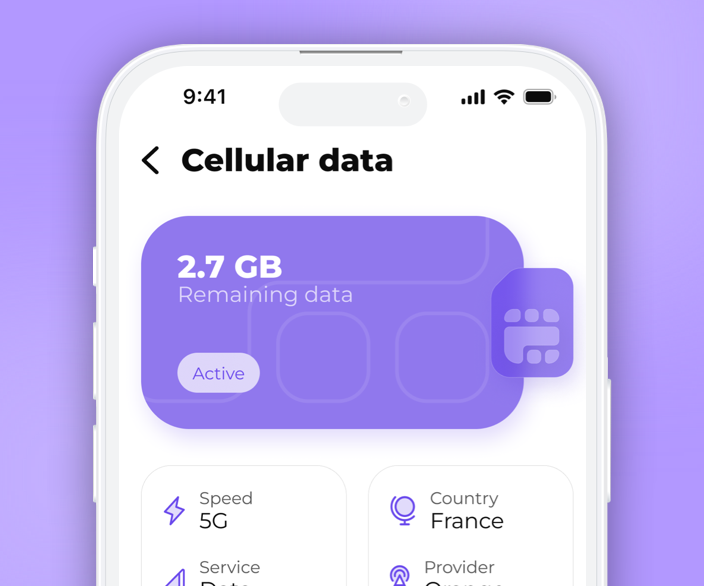
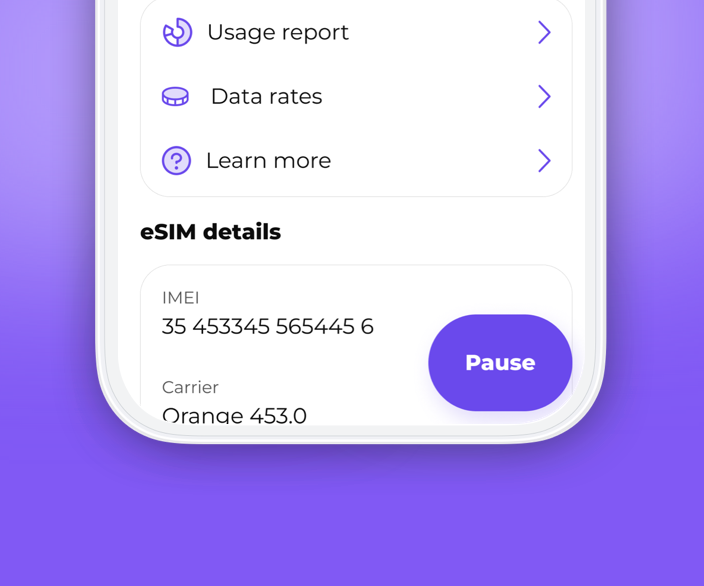
The short version:
• Three networks, one profile: Rogers Wireless, Bell Mobility and Telus Mobility, selected automatically by signal strength.
• Billed by the gigabyte: the Canada per-GB rate, with no bundles, no contract and no roaming surcharge bolted on.
• Ready before wheels-up: scan the QR code at home and land connected in Toronto, Calgary or Vancouver.
• Keeps going at the border: cross into the United States and your data simply reprices, with nothing to swap.
• Credits that outlast the trip: any unused balance never expires and travels to your next country.
How do you keep one phone working from a Halifax pier to a Tofino beach without handing your carrier a four-figure roaming bill? You stop buying roaming altogether. A SLYNUMBER eSIM downloads onto the handset already in your pocket, connects to Canada's three national networks, and charges by the gigabyte — so a week of maps through the Rockies costs precisely what it costs, and not a cent of that is a surcharge.
Networks and coverage across Canada
Your profile rides three national carriers — Rogers Wireless, Bell Mobility and Telus Mobility — and the handset decides which one to use, re-checking as you move between the city and the highway. There is nothing to configure and no menu to go hunting through.
5G and LTE: Canada keeps widening its 5G footprint year on year. Opensignal's Canada Mobile Network Experience reporting puts users in Toronto, Montreal, Vancouver, Calgary and Ottawa on 5G for over 33% of their connected time, averaging above 255 Mbps on download. Figures from the national regulator, CRTC (Canadian Radio-television and Telecommunications Commission), put 4G/LTE within reach of more than 99% of the population, with suburban averages of 55–110 Mbps.
Past the border: the Canada per-GB rate applies while you are registered on a Canadian network. Drive into the United States, or fly out to Greenland or Saint-Pierre-et-Miquelon, and each is billed at its own rate — every one of them published on the SLYNUMBER destinations page. Nothing to switch, nothing to reinstall, and your credits roll across with you.
Devices that work: iPhone XS and newer, Google Pixel 3 and newer, Samsung Galaxy S20 and newer in carrier-unlocked form, plus most eSIM-capable tablets. Unsure about yours? Open Settings → Cellular → Add eSIM before you buy — if the option is sitting there, so is your eSIM.
1. Why distance travellers pick SLYNUMBER
Canada is not a country you finish in a weekend. Five and a half time zones, a rail corridor longer than most European nations, highways where the next town is a two-hour commitment. A phone plan designed for a city break falls apart out there.
Pay for the ground you cover
You buy gigabytes, you use gigabytes, and that is the entire transaction. No monthly allowance sitting untouched while you are out of range in Jasper, and no bundle that lapses the day before your flight home. On a long itinerary that flexibility matters: some days are all offline hiking, others are three straight hours of navigation across the prairies. Pay-as-you-go absorbs the swing without complaint. Top up inside the app whenever the balance looks thin, and whatever survives the trip stays on your account waiting for the next one.
Connected the minute you land
Install the profile at home, in your own time, on your own Wi-Fi. Scanning the QR code takes under a minute and adding it by hand takes barely longer. When the wheels touch down at Pearson, Trudeau or YVR you flip the switch and the phone finds a network before you have cleared the jet bridge. No queue at an airport kiosk, no hunting for a tray tool, no borrowing terminal Wi-Fi just to activate the thing you bought to avoid needing terminal Wi-Fi.
One profile, the rest of the map
Canada is rarely the only stamp in a passport. The same eSIM covers 120+ countries, so a trip that begins in Vancouver and ends in Seoul or Sydney runs on one profile the whole way through. Cross a border and the phone re-registers locally, then bills that country's rate. Leftover credits from the Rockies work perfectly well in Lisbon eighteen months later, because they do not expire. One install, one app, one balance to watch — instead of a drawer of half-used travel SIMs and a separate login for each.
Nobody has to learn a new number
Your primary line stays exactly where it is. The eSIM supplies data alongside it, so WhatsApp, iMessage and Signal keep running on the number your contacts already have, and any code sent to your home line still arrives. If you also want a permanent U.S. mobile number — one that verifies with banks and marketplaces without being flagged as VoIP — SLYNUMBER provides that inside the same app. Two numbers on one handset, and not a single physical tray opened at 30,000 feet.
2. Coverage, region by region
Signal in Canada tracks population, and population tracks the southern edge of the map. Here is what to expect on each leg of a cross-country run.
Windsor through to Quebec City
This is the densest stretch of the country and comfortably the best served. Toronto, Ottawa and Montreal all post heavy 5G time, and the LTE floor along Highway 401 and the VIA Rail Corridor rarely drops out. Expect quick uploads from Union Station, the Rideau Canal and Old Quebec, and dependable routing on both the TTC subway and the Montreal Metro.
Calgary, Banff and the Icefields
Calgary runs solidly on 5G, and the townsites of Banff, Canmore and Jasper hold usable LTE. The Icefields Parkway strung between them is the honest exception: long valley and pass sections where signal thins or disappears entirely. Download your route plus any Lake Louise or Moraine Lake trail maps before leaving town, and the phone picks a network back up on its own as you drop into the next valley.
Vancouver, Victoria and the ferries
Vancouver, Burnaby and Victoria are well covered, with 5G showing up around Gastown, Granville Island and the Stanley Park Seawall. BC Ferries sailings from Tsawwassen to Swartz Bay keep a workable connection for most of the crossing, with a soft patch mid-strait. Whistler and the Sea-to-Sky Highway hold LTE for almost the entire climb.
Big sky, thinner bars
Winnipeg, Regina, Saskatoon and Edmonton behave like any Canadian city: fast and stable. Between them the Trans-Canada Highway keeps LTE near the towns and grain terminals, with gaps through the empty middle. Head for Yellowknife, the Yukon or the Canadian Shield and coverage becomes a settlement-by-settlement affair. Cache your maps, then treat every bar you get as a bonus rather than a right.
3. Three steps, done before takeoff
Nothing here needs an airport, a shop or a paperclip. Fifteen minutes at the kitchen table covers the lot.
Download the app,
choose Canada
Grab SLYNUMBER from the App Store or Google Play, set up an account and select Canada. Data is priced by the gigabyte and bought separately from the plan, and there is a one-time $5 eSIM activation fee on the profile itself. Start modest — topping up mid-trip takes seconds.
Install the profile
while you are still home
The app hands you a QR code. Scan it, or add the eSIM by hand in your device settings, and the profile writes itself onto the phone. Do this before you fly: installation needs a connection, and your own Wi-Fi is a far better place for that than an airport lounge network shared with three hundred people.
Turn it on,
let it choose
After landing, enable the SLYNUMBER eSIM in your settings. The handset registers on Rogers Wireless, Bell Mobility or Telus Mobility by itself, always taking the strongest signal available, and re-evaluates that choice as you move between downtown and open road.
4. Where your gigabytes actually go
Four apps do most of the damage on a Canadian trip. Here is roughly what each one costs you, and the places you will be using it.
Calling home across the time zones
Your existing WhatsApp number stays exactly as it is — the eSIM supplies data, not a new identity, so nobody has to re-add you. Voice calls run about 3 to 8 MB a minute, which makes a nightly check-in from a Banff hotel or a Montreal apartment cost roughly a coffee's worth of data across a fortnight. Share a live location with whoever is collecting you at Union Station, drop photos into the family group from the Stanley Park Seawall, take a video call on a Kensington Market patio. Because this is real mobile data rather than crowded café Wi-Fi, calls hold together instead of breaking up at the worst possible moment.
Posting from the viewpoints
Canada hands you more frames than storage. Stories from the CN Tower observation deck, a Reel of the mist rolling off Niagara Falls from the Canadian side, a carousel shot around the Plateau Mont-Royal at golden hour — all uploaded where you stood, rather than queued until the hotel Wi-Fi cooperates. A 60-second 1080p Reel runs roughly 50 to 80 MB, so a genuinely prolific week of posting still sits comfortably inside a few gigabytes. Rogers, Bell and Telus all push strong LTE through city centres and the major tourist sites, and Instagram keeps a local copy of whatever you shoot, so a dead spot inside a gallery costs you nothing at all.
Filming the long way round
The road-trip format was practically invented for this country. Film a POV walk through St Lawrence Market, a time-lapse of the Rideau Canal freezing over, the chuckwagons at the Calgary Stampede in July or the queues outside a screening at the Toronto International Film Festival each September. A standard 60-second upload eats somewhere between 30 and 100 MB depending on the resolution you export at. Automatic selection across the three carriers keeps you posting from inside packed venues where a single-carrier SIM would stall completely. The SLYNUMBER app shows your balance live, so you know before hitting upload whether a top-up is due.
Navigation over very long distances
This is the app that quietly spends your data. Live routing along the Trans-Canada Highway, transit directions on the TTC subway and the Montreal Metro, cycling turns around the Stanley Park Seawall, hunting for somewhere still open near the CN Tower at eleven at night. Coverage holds across the cities and most intercity routes, but the Icefields Parkway, the Canadian Shield and the Yukon will drop you without warning. Download the offline region before departure — the whole of Canada comes in under 1800 MB, and a single province is far smaller. The instant signal returns, routing goes live again and your arrival time corrects itself.
Best eSIM for Canada
Two minutes of video, start to finish, so you can watch the whole setup before committing to it.
Watch a SLYNUMBER eSIM for Canada go from app download to an active connection on a Canadian network, with the QR install and the settings toggle shown in full.
6. How the alternatives compare
Airport SIMs, second-number apps and carrier roaming add-ons all claim to solve the same problem. The table below lines them up beside SLYNUMBER on price, on privacy, and on how long the number actually survives once you stop paying.
| Feature |
SLYNUMBER |
Google Voice |
Burner Apps |
Carrier 2nd line |
| Real U.S. mobile number | Yes | No | Varies | No |
|---|
| SMS verification for apps | Yes | Limited | Often blocked | Yes |
|---|
| Immune to SIM swapping | Yes | Yes | Yes | No |
|---|
| Custom voicemail | Yes | Yes | Rarely | Yes |
|---|
| International calling | Yes | Limited | Rarely | Carrier dependent |
|---|
| eSIM / Data plans | Yes | No | No | Carrier dependent |
|---|
| Number permanence | Permanent | Permanent | Temporary | Permanent |
|---|
| Requires carrier number | No | Yes | Varies | Yes |
|---|
| Starting price | $14.99 / 3 months | Free | $2–$5/week | $10–$15 add-on |
|---|
7. Features and pricing
Everything included
One account covers two jobs: travel data billed by the gigabyte, and a permanent U.S. mobile number that behaves like an ordinary line. The full list:
- A real U.S. mobile number — a proper mobile line that verification screens accept, never marked as VoIP
- Pay-as-you-go eSIM data across 120+ countries, billed by the gigabyte
- The number reaches you from 150+ countries over any data connection
- Call, SMS and MMS credits carrying no expiry date whatsoever
- QR-code installation in a couple of minutes, no shop and no paperwork
- Live usage tracking, instant top-ups and plan changes from the app
- The SlyAI assistant built in, for setup questions at awkward hours
The line is a genuine U.S. mobile number rather than a VoIP address, which is exactly why verification goes through: WhatsApp, Telegram, PayPal, Venmo, Instagram, Snapchat, Amazon and Gmail all accept it without argument.
Private in transit
Calls and messages move over TLS and SRTP encryption, so the airport lounge network you borrowed for ten minutes never gets a readable copy of anything you said.
What it costs
Two cycles for the number, one credit system for talk and text, and a one-time $5 activation fee for the eSIM itself.
- Quarterly: $14.99 every 3 months, which works out to $4.99 a month
- Annual: $49.99 for the year, the cheapest way to hold the number
- Credits: $10 buys 1,000 — one credit covers a minute of talk, one SMS or one MMS, and data credits are purchased separately and never expire
Where to get it
SLYNUMBER lives on the App Store and Google Play. Buy data, install the eSIM, watch your balance and put a question to the SlyAI assistant — all from one screen, before the trip, during it, and long after you are home.
8. Canada eSIM questions
Yes, because the Corridor route follows populated ground the entire way. VIA Rail Canada covers roughly 541 km between Toronto and Montreal in about five hours, threading through territory served by Rogers, Bell and Telus, the three networks your eSIM moves between on its own. Expect continuous 4G/LTE, with 5G appearing around Toronto Union Station and Montreal Gare Centrale. Rural pockets along the St Lawrence can thin out for a minute or two. On longer cross-country runs the gaps last rather longer, so cache maps and playlists during station stops.
It does. The profile is global, so the moment your handset finds a network south of the line it re-registers and carries on. What changes is the price per gigabyte: the Canada rate stops at the border and U.S. data is billed at the U.S. rate, exactly as published on the SLYNUMBER destinations page. The same holds if you fly to Greenland or Saint-Pierre-et-Miquelon. No second profile, no APN edits, nothing to swap at the crossing. Unused credits travel with you, never expire, and follow you back north afterwards.
Budget 6 to 8 GB for ten days if you are genuinely covering ground. Navigation is the quiet expense: turn-by-turn along the Trans-Canada Highway plus transit routing on the TTC subway and the Montreal Metro adds up faster than messaging ever does. Travellers who mostly text and glance at maps land near 3 GB. Add a nightly video call home across four time zones and you are closer to 6 GB. Stream in the hotel or hotspot a laptop in Calgary and 10 GB is realistic. Top up mid-trip in seconds; leftovers keep.
It is a real U.S. mobile number that lives inside an app instead of a plastic SIM tray. Calls, texts and picture messages arrive over your data connection, which means the number reaches you in a Banff cabin, on a Vancouver ferry or back at a desk in Toronto, wherever there is signal. Nothing is welded to a single handset, so the same line follows you between phones and tablets. And because it is a genuine mobile number rather than a VoIP address, services that reject internet numbers treat it as perfectly ordinary.
Burner numbers are rented, recycled and gone the moment you stop paying, and the platform that issued yours may hand it to a stranger weeks later along with any codes still routed there. A SLYNUMBER line stays yours for as long as the plan runs, which matters a great deal when it sits on a bank login or a shipping account. It also behaves like an ordinary mobile number rather than a VoIP one, so verification screens accept it. Cheap for a weekend turns expensive the day a login stops working in Calgary.
Two cycles exist. The quarterly plan bills $14.99 every three months, which works out to $4.99 a month, and the annual option is $49.99 up front for twelve months. Talking and texting run on credits: $10 buys 1,000, and one credit covers a minute of conversation, one SMS or one MMS. Credits never expire, so a quiet stretch between trips costs nothing extra. Travel data is separate and priced by the gigabyte per country. Setting up the eSIM itself carries a one-time $5 activation fee.
Considerably harder. A SIM swap works by persuading a carrier employee to move your number onto somebody else's SIM card, usually with details scraped off social media. There is no physical SIM behind a SLYNUMBER line and no retail counter to social-engineer, so that route simply closes. The number sits behind your account login rather than a chip in a phone you might leave in a taxi. Traffic is encrypted in transit with TLS and SRTP. Lose the handset somewhere between Ottawa and Halifax and you sign in on a new one.
Yes, and for many travellers that is the whole reason to buy one. It is a genuine U.S. mobile number, so WhatsApp, Telegram, PayPal, Venmo, Instagram, Snapchat, Amazon and Gmail accept it for verification instead of bouncing it as a VoIP line. Codes arrive in the app over data, which is the part that saves you real trouble: no waiting on a home carrier to forward an SMS across a border, and no roaming charge for the privilege. Your logins behave the same in Whistler as they do at home.
It will. The number is not pinned to a country, it is pinned to your data connection. Land in Tokyo, Lisbon or Mexico City, connect through the eSIM or hotel Wi-Fi, and calls and texts arrive on the same U.S. line your contacts already have saved. The number service reaches you from 150+ countries and the eSIM data side covers 120+, so the two travel together comfortably. Nobody has to learn a replacement number, and you are not paying international rates simply to answer.