Field notes:
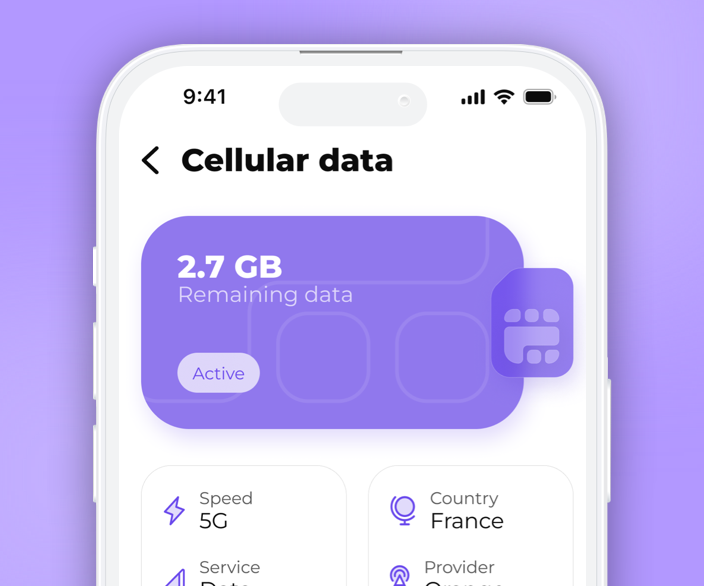
• Metered, not bundled: data is billed at the Belarus per-GB rate, so a slow week costs less than a busy one.
• Three networks, one profile: A1 BY, MTS BY and life:) are all in play, selected automatically by signal.
• Installed before departure: scan the QR code on home Wi-Fi and land already connected.
• Coverage where the work happens: Minsk, Gomel, Mogilev, Vitebsk and Hrodna, plus the intercity corridors between them.
• Your number stays put: the same U.S. mobile line keeps banks, clients and two-factor codes working.
A roaming day-pass looks harmless at breakfast and turns into a three-figure line item by the end of a thirty-day stay — and the fair-use cap usually bites somewhere around week two. The other habit, buying a local prepaid SIM at the airport, hands you a second number your bank has never seen and a queue you did not plan for. SLYNUMBER's Belarus eSIM takes the third road: metered data on A1 BY, MTS BY and life:), a U.S. mobile number that never changes, and one app tracking both.
Networks, speeds and devices in Belarus
Host networks: your SLYNUMBER eSIM registers on A1 Belarus, MTS Belarus or life:) (Turkcell) — whichever is strongest at your desk — and re-selects on its own as you move between them. There is nothing to configure by hand.
5G and 4G reality: according to Opensignal's Belarus Mobile Network Experience reporting, users in Minsk, Gomel, Mogilev, Vitebsk and Hrodna spend over 8% of their connected time on 5G, averaging above 130 Mbps when they are on it. Figures from BelGIE (Ministry of Communications) put 4G/LTE reach beyond 98% of the population, with suburban averages of 25–55 Mbps — plenty for a day of video calls.
Crossing a border: the Belarus per-GB rate applies only while you are on a Belarusian network. Drive into Poland, Lithuania or Ukraine and billing shifts to that market's published rate, every one of them listed on the SLYNUMBER destinations page. No new eSIM, no settings to touch, and your credit balance rolls over with you.
Device check: the profile installs on iPhone XS and newer, Google Pixel 3 and newer, Samsung Galaxy S20 and newer (carrier-unlocked models) and most eSIM-capable tablets. Open Settings → Cellular → Add eSIM before you buy to confirm your handset qualifies.
1. What changes when you stop roaming
Four practical differences between a SLYNUMBER eSIM and the usual options, seen from the point of view of someone staying long enough to unpack properly.
Buy gigabytes in steps
A fixed bundle asks you to predict a month you have not lived yet. Guess low and you are re-buying on day nineteen; guess high and you have donated the difference. Metering removes the guess: data is billed at the Belarus per-GB rate, you top up when the app tells you the balance is thin, and anything left over stays in the account with no expiry date. Quiet weeks in a Minsk apartment and heavy weeks of client calls settle up honestly, without a plan change.
When to stop trusting the router
Café Wi-Fi is fine for email and unreliable for anything that matters. A shared router on Zybitskaya Street at seven in the evening will drop a screen share halfway through, and hotel networks throttle uploads without telling you. The habit worth building: draft on Wi-Fi, present on cellular. Switch the eSIM to your primary data line for calls, demos and large uploads, then flip back for background syncing. You are paying by the gigabyte, so the cellular fallback costs a few cents of certainty rather than a monthly fee.
One line for clients and banks
The quiet cost of a local SIM is administrative. Every account that trusts your old number has to be re-verified, and the ones that refuse foreign numbers simply lock you out. SLYNUMBER keeps a genuine U.S. mobile number attached to your account for the whole stay, so invoices, one-time passcodes and the client who only ever texts all keep landing in the same place. The eSIM handles data, the number handles identity, and neither depends on you standing in a shop with a passport.
The next base is already covered
Nomad itineraries rarely end at one country, and Belarus sits inside a comfortable radius of several others. The same profile connects to data in 120-plus destinations and the number reaches you from 150-plus, so moving on means booking transport rather than re-doing your setup. Unused credits follow you because they never expire. Whether the next month is spent in a Baltic capital, a Polish coworking space or back home, you keep the same install, the same login and the same running usage history.
2. Where you'll actually be working
Coverage is never a single number. Here is how the signal behaves in the four settings a long-stay visitor spends real hours in.
The capital, floor by floor
Minsk is the easy part. All three host networks run dense 4G across the centre, with 5G showing up around Independence Avenue, the Upper Town and the main transport hubs, and the Metro keeps a usable signal between stations. The variable is the building, not the city: thick Soviet-era walls and basement cafés will cut bars in a way the street outside does not. If a call matters, take it near a window or step out to the courtyard — the network is there, the concrete is the problem.
Gomel, Mogilev, Vitebsk and Hrodna
The regional cities are quietly good places to work, and the data reflects it. Suburban averages of 25 to 55 Mbps hold up for video calls, cloud drives and the occasional large export, and 5G surfaces in the central districts. Vitebsk gets busy every July when the Slavianski Bazaar fills the town, which is the one week you may notice congestion in the evenings. Hrodna, closer to the Polish frontier, is the natural base if your month includes regular hops across the border.
Forests, castles and the M1
Weekends pull you out of coverage comfort. Belovezhskaya Pushcha thins out under the tree cover, and the quieter roads through Polesia and the Vitebsk region drop to a bar or two. Mir Castle and Nesvizh Castle are both fine for posting from the grounds. The M1 corridor between Minsk and the Polish border stays connected for the length of the drive. Download the map region and any long-form audio before you leave the city, and treat Saturday as a genuinely offline day.
Out to Poland, Lithuania or Ukraine
Border days are the ones people worry about and rarely need to. Your handset lets go of the Belarusian network and registers on the neighbouring one within a minute or so of crossing, then meters at that country's rate. The practical advice is unglamorous: keep the eSIM enabled while you queue, expect the switch to happen somewhere in the no-man's-land between posts, and check the app once you are through so you know which rate is running before you start a long call.
3. Three steps, two of them at home
Steps one and two belong to the night before your flight. Step three takes about ten seconds at the arrivals hall.
Get the app,
buy Belarus data
Install SLYNUMBER from the App Store or Google Play, create an account and select a Belarus data plan. The one-time $5 eSIM activation fee appears at checkout; data credits are a separate purchase you can add whenever you like.
Install the profile
before departure
On home Wi-Fi, scan the QR code the app generates or add the eSIM manually in your device settings. Two minutes, one restart at most. The profile then sits inactive in your settings until the day you want it, using nothing in the meantime.
Land, toggle on,
start working
Switch the SLYNUMBER line on in your settings once you have landed. It registers with A1 BY, MTS BY or life:) automatically, picking the strongest signal, and you are online before you reach passport control.
4. Your working apps on Belarusian networks
Realistic numbers for the four apps that eat a nomad's month, and the places in Belarus where each one earns its keep.
Client calls without the SIM swap
Your existing WhatsApp account keeps working on SLYNUMBER data, because nothing about your number changes — no swap, no re-verification, no explaining a new contact to a client mid-project. A voice call costs roughly 5 MB a minute, so an hour of check-ins runs about 300 MB and a full month of daily calls stays comfortably under a gigabyte. Video is heavier and worth taking on cellular anyway. The pattern that works in Belarus: take scheduled calls on the eSIM from your apartment or the Upper Town, and treat café Wi-Fi as a backup rather than the main line, since a shared router drops screen shares far more often than a 4G cell in central Minsk does.
Posting between work blocks
Stories are the cheapest content you will publish and Reels are the expensive ones. A 60-second Reel at 1080p uploads at around 65 MB, so a daily posting habit costs about 2 GB across a month — noticeable in a metered plan, easy to plan for. Belarus gives you plenty to point a camera at between work blocks: Independence Avenue in the late light, the courtyards of Trinity Hill, Mir Castle and Nesvizh Castle on a day trip west, or the beech stands of Belovezhskaya Pushcha. All three host networks hold 4G at those sites. Let Instagram save drafts locally when the signal thins, then push the upload once you are back on a strong cell rather than fighting a weak one.
Filming the city you're living in
Long stays produce better short-form video than holidays do, because you eventually film the ordinary things. A one-minute clip uploads at anywhere between 30 and 100 MB depending on the resolution you export, so a couple of posts a week is a modest slice of a monthly budget. Shoot a walk down Zybitskaya Street as the bars fill, a lap of the Minsk Metro's older stations, or the crowds at the Slavianski Bazaar in Vitebsk each July and the Kupala Night fires at midsummer. Automatic network selection across A1 BY, MTS BY and life:) matters most in those packed venues, and the SLYNUMBER app shows the balance dropping in real time as the upload runs.
Getting to the desk and back
Navigation is the least glamorous line in your data budget and the one you will miss immediately if it stops. Live Google Maps handles Minsk Metro routing, cycling directions around Komsomolskoye Lake and finding an open café near Independence Avenue on a Sunday, and consumes very little in the process. Where it earns its keep is out of town: the quieter roads through Polesia and the Vitebsk region have real gaps, and the M1 run toward the Polish border is long enough that you want the route cached. A full offline map of Belarus is under 520 MB downloaded once on Wi-Fi, and live navigation resumes automatically the moment the signal returns.
Best eSIM for Belarus
If you would rather watch the flow than read it, the whole thing is about two minutes of screen recording.
The complete Belarus setup on camera: choosing a data plan in the SLYNUMBER app, installing the eSIM from a QR code, and the first connection to a Belarusian network.
6. SLYNUMBER next to the usual workarounds
Long stays expose the weak points of every quick fix: burner apps recycle numbers, a local prepaid SIM hands you a line your bank does not recognise, and plain VoIP gets rejected at sign-up. The table lines each option up against SLYNUMBER on verification success, SIM-swap exposure, expiry rules and what happens the moment you cross a border.
| Feature |
SLYNUMBER |
Google Voice |
Burner Apps |
Carrier 2nd line |
| Real U.S. mobile number | Yes | No | Varies | No |
|---|
| SMS verification for apps | Yes | Limited | Often blocked | Yes |
|---|
| Immune to SIM swapping | Yes | Yes | Yes | No |
|---|
| Custom voicemail | Yes | Yes | Rarely | Yes |
|---|
| International calling | Yes | Limited | Rarely | Carrier dependent |
|---|
| eSIM / Data plans | Yes | No | No | Carrier dependent |
|---|
| Number permanence | Permanent | Permanent | Temporary | Permanent |
|---|
| Requires carrier number | No | Yes | Varies | Yes |
|---|
| Starting price | $14.99 / 3 months | Free | $2–$5/week | $10–$15 add-on |
|---|
7. Features and pricing in full
What's in the box
One account covers both halves of the problem — the number and the data. The checklist:
- A genuine U.S. mobile number that passes platform verification instead of being flagged as VoIP
- Use the number from 150+ countries and connect eSIM data in 120+
- Data metered at each country's published per-GB rate, Belarus included, with no bundles
- Credits with no expiry date, carried across borders and between trips
- Automatic selection between A1 BY, MTS BY and life:) while you are in Belarus
- SlyAI assistant built into the app for setup questions at awkward hours
- Live usage meter, one-tap top-ups and plan changes from the phone in your hand
To WhatsApp, Telegram, PayPal, Venmo, Instagram, Snapchat, Amazon and Gmail it reads as an ordinary U.S. mobile line, which is why registration and SMS verification go through on the first try.
Security
Data rides TLS and calls are secured with SRTP. There is no physical card to steal and no retail counter where a stranger can social-engineer a port-out, so the classic SIM-swap route is closed — reaching your number requires your app credentials, full stop.
The price list
A base plan for the number, credits for talk and text, data metered separately, and a single activation fee the first time the eSIM installs.
- Number plan: $4.99 a month on the quarterly cycle, billed $14.99 every 3 months
- Annual alternative: $49.99 a year
- Credits: $10 for 1,000 — one credit is one call minute, one SMS or one MMS
Apps and devices
SLYNUMBER is on the App Store and Google Play with the SlyAI assistant included. The eSIM installs on iPhone XS and newer, Google Pixel 3 and newer, Samsung Galaxy S20 and newer (carrier-unlocked) and most eSIM-capable tablets.
8. Belarus eSIM FAQ
Mostly, yes. The Minsk–Brest run covers about 347 km in three and a half hours, and the corridor sits inside A1 BY, MTS BY and life:) coverage almost end to end, so calls and file syncs hold up. Expect steady 4G, with 5G around the terminals at Minsk-Passazhirsky and Brest Tsentralny. The forested stretches near Belovezhskaya Pushcha are the weak spot. Book deep work rather than a client demo for those twenty minutes, and cache your offline maps and playlists before the train pulls out.
It does, and it does it on its own. The Belarus per-GB rate applies while your handset is registered on a Belarusian network; once you clear the border into Poland, Lithuania or Ukraine, billing moves to that country's published rate, all of which sit on the SLYNUMBER destinations page. Nothing changes on your side: no second profile, no APN edit, no re-scanning a QR code. Credits are pooled and never expire, so a balance bought for a month in Minsk still spends in Vilnius, Warsaw or Lviv.
Budget by habit rather than guesswork. A writer or designer who uses cellular only for maps, messaging and the odd tethering emergency lands near 6 to 8 GB a month. Add an hour of daily video standups over mobile data and you are closer to 18 to 22 GB. Hotspot a laptop through a full working week and 30 GB is realistic. Metering at the Belarus per-GB rate means you buy in steps as the month goes on, and the app shows your running total long before payday.
It is a real U.S. mobile number that lives in the app instead of a plastic SIM tray. You place and answer calls, send SMS and MMS over data, and keep the same line whether you are in Minsk for a season or back home for a fortnight. Because it is a genuine mobile number rather than a VoIP-flagged one, WhatsApp, Telegram, PayPal, Venmo, Instagram, Snapchat, Amazon and Gmail all accept it for sign-up and verification.
Burner apps recycle their numbers. That is tolerable for a one-off classifieds listing and awful for a long stay: the number you gave your bank in March can belong to a stranger by June, and plenty of services already treat those ranges as VoIP and refuse them. A SLYNUMBER line stays yours for as long as the plan is active, clears verification on the first attempt, and keeps calls encrypted rather than pushing them through an ad-funded gateway.
Three line items, no surprises. The number plan is $4.99 per month on the quarterly cycle, billed $14.99 every three months, or $49.99 for a full year if you are settling in. Calling and texting run on credits: $10 buys 1,000, and one credit equals one minute of talk, one SMS or one MMS. Data is separate and metered at the Belarus per-GB rate. Installing the eSIM the first time adds a one-time $5 activation fee. Credits never expire.
Far less than with a physical SIM. There is no card for a hotel thief to lift and no shop counter where someone can talk an agent into porting your line, because the number is bound to your SLYNUMBER account and unlocked by your app login. Traffic runs over TLS and calls are protected with SRTP. If a handset disappears on the Minsk Metro, you sign in on a replacement device and the number arrives with you.
Yes, and that is the whole argument for paying for a real line. One-time passcodes from banks, brokerages, marketplaces and work single sign-on land in the SLYNUMBER app over your eSIM data, so a foreign network never quietly breaks your logins. Attach the number to your accounts before you leave and nothing needs re-verifying while you are settled in Minsk, Hrodna or wherever the next month takes you.
All of it. The number works from 150-plus countries and the same eSIM connects to data in 120-plus, so your next base needs nothing more than a flight. Leftover credits travel with you because they carry no expiry date, and the balance simply meters at whatever rate the new country publishes. One install, one login, one number your clients and your bank have already learned.