At a Glance:
• What you pay: data metered by the gigabyte at the El Salvador rate, with no daily roaming fee stacked on top.
• Setup: install by QR code the night before you fly, then switch it on after landing at Comalapa.
• Where it works: Tigo, Claro and Movistar cover San Salvador, Soyapango, Santa Ana, San Miguel, Mejicanos and the La Libertad surf coast.
• Your number: WhatsApp and iMessage keep running on the number you already have.
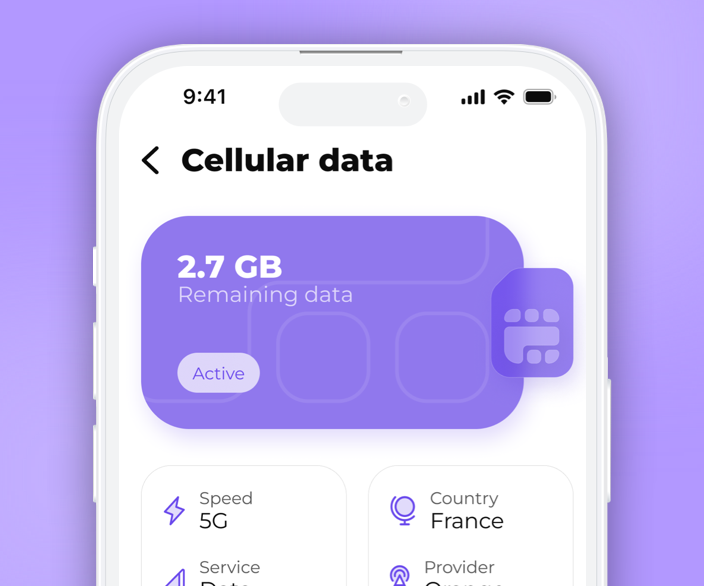
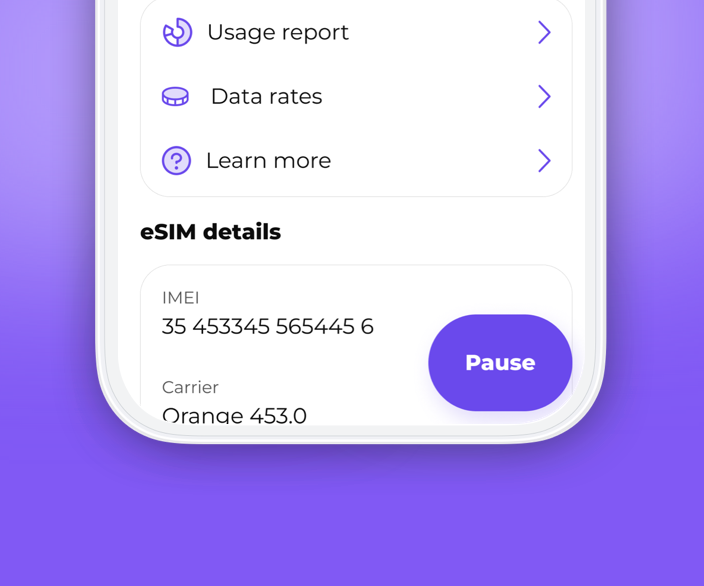
• Control: check usage, top up and change plans in the SLYNUMBER app while you travel.
Do the arithmetic before you fly. A typical international add-on from a home carrier runs $10 to $15 a day in El Salvador, so a ten-day surf trip means $100 to $150 for data you may barely touch between paddle-outs. SLYNUMBER charges the El Salvador per-GB rate on what you actually use, adds a one-time $5 activation fee, and stops there — no daily charge, no bundle to burn through, and no bill arriving three weeks after you get home.
Networks and coverage in El Salvador
Host networks: your profile rides on three carriers here — Tigo El Salvador, Claro El Salvador and Movistar (now part of Claro). The handset compares signal and attaches to the strongest of them wherever you stop, then reselects on its own when you swap the capital for the coast. There is nothing to configure and no network to pick from a menu.
5G: the footprint is real but still largely urban. Opensignal's El Salvador Mobile Network Experience reporting puts users in San Salvador, Soyapango, Santa Ana, San Miguel and Mejicanos on 5G for more than 11% of their connected time, averaging above 155 Mbps down. 4G/LTE: figures from the regulator SIGET (Superintendencia General de Electricidad y Telecomunicaciones) show LTE reaching more than 97% of the population, with suburban averages of 22–55 Mbps — comfortable for navigation, uploads and video calls.
Across the border: the El Salvador per-GB rate applies only while your phone is attached to a Salvadoran network. Cross into Guatemala, Honduras or Nicaragua and billing switches to that country's rate, every one of which is listed on the SLYNUMBER destinations page. There is no second eSIM to install and no setting to change, and your remaining credits keep spending.
Devices: the eSIM works on iPhone XS and newer, Google Pixel 3 and newer, and Samsung Galaxy S20 and newer provided the handset is carrier-unlocked, plus most eSIM-capable tablets. Check yours in Settings → Cellular → Add eSIM before you buy — if that option appears, you are covered.
1. What an El Salvador eSIM gets you
Four things decide whether travel data is worth buying: what it costs, what gets added on top, when it starts working, and where it stops. Here is how SLYNUMBER answers each one.
Pay for gigabytes, not packages
There is no weekly bundle to choose and nothing to forfeit at the end of it. You buy data credit, the El Salvador per-GB rate is drawn against it while your phone is on a Salvadoran network, and whatever you do not use stays in the account. Credits never expire, so loading an extra gigabyte before a long coastal drive costs you nothing if the drive turns out to be shorter than planned.
Nothing added on the way home
The price you can see before you fly is the price you get. A home carrier's international add-on stacks a daily fee on top of whatever you consume, and the total only surfaces weeks later. SLYNUMBER has no daily fee, no overage tier and no mystery line item — just the per-GB rate for the country you are standing in, deducted as you go and visible in the app in real time.
Set up at home, working on landing
Install the profile the night before, while you still have a stable connection, and leave it switched off. When the wheels touch down at Comalapa you enable it in Settings and the handset finds a host network within a minute or two. No airport SIM counter, no passport photocopy, and no hunting for a kiosk that happens to be open when your flight lands at midnight.
The same eSIM covers the rest of the trip
Most people pair El Salvador with something else — a week in Guatemala, a flight home through Panama, a return trip next swell season. The profile you install for this trip works in more than 120 countries, each billed at its own rate, without a second purchase or a second QR code. Leftover credit rolls straight into the next destination instead of expiring.
2. Coverage, region by region
El Salvador is small enough to cross in a morning, which flatters its network map: LTE reaches over 97% of the population. Here is what to expect in the four places a coastal trip actually goes.
The capital and its ring of suburbs
This is the strongest ground in the country. San Salvador, Soyapango, Mejicanos and the neighbouring municipalities carry dense LTE plus a genuine 5G layer, so hotspotting a laptop from a cafe in Colonia Escalón or Zona Rosa is entirely practical. Congestion along the SITRAMSS corridor can slow uploads at six in the evening; speeds recover as soon as the traffic does.
Puerto de La Libertad, El Tunco, El Zonte and south
This is the most visited stretch of coastline in El Salvador and the towers reflect that. Expect solid LTE through Puerto de La Libertad, El Sunzal, El Tunco and El Zonte, thinning as you continue past Mizata toward the Sonsonate line. Beach-level signal can drop behind headlands and cliffs, and walking twenty metres up the access road usually fixes it. Download tide tables rather than refreshing them.
The western highlands
Santa Ana city is well served, as are the main Ruta de las Flores towns — Nahuizalco, Salcoatitán, Juayúa, Apaneca and Ataco — where LTE is usually fine in the plaza and unreliable ten minutes up a coffee track. The climb to Cerro Verde and the Santa Ana volcano trailhead loses signal in stretches, and the rim road above Lake Coatepeque drops in and out. Pin your route before setting off.
Eastern cities and the Gulf coast
San Miguel anchors the east with reliable LTE, and the Panamericana toward El Amatillo stays connected the whole way. Coverage thins off the main road: the mangrove channels of Bahía de Jiquilisco, the back lanes to Playa El Cuco and Las Flores, and the higher ground toward Perquín. It is workable rather than seamless, and offline maps earn their keep here more than anywhere else in the country.
3. Three steps, done before the board bag is packed
Total setup time is under ten minutes, and all of it happens at home rather than at an airport counter.
Install the app,
buy your data
Download SLYNUMBER from the App Store or Google Play, create an account and choose your cycle — $4.99 a month billed quarterly at $14.99, or $49.99 for the year. A one-time $5 eSIM activation fee applies, and data credits are bought on top at the El Salvador rate.
Add the eSIM
by QR code
Scan the QR code the app gives you, or enter the activation details by hand if you prefer. Do this while your home connection is still reliable — the profile installs in seconds and then sits dormant on the device. Leave it switched off so it draws nothing before you travel.
Switch it on,
land connected
On arrival, enable the SLYNUMBER eSIM in your cellular settings. The handset attaches to Tigo, Claro or Movistar — whichever is strongest where you are standing — and reselects by itself as you move from the capital down to the coast. No APN edits and no manual carrier picking.
4. Your apps on Salvadoran networks
What the connection feels like in the four apps that actually get used on a coastal trip, and what each one costs in data.
Keep your own WhatsApp number live
WhatsApp is how El Salvador runs: surf camps confirm beds on it, shuttle drivers send pickup pins on it, instructors post the morning swell report on it. Your existing number stays live on eSIM data, so nothing changes except the connection underneath. A voice call costs roughly 4 MB a minute, which puts a fortnight of daily check-ins under 400 MB. Video calling from the malecón at Puerto de La Libertad runs nearer 10 MB a minute, so save it for evenings. Voice notes, location shares and photo dumps from El Sunzal are trivial by comparison, and because the data is not throttled, calls hold better than they do on shared beach-bar Wi-Fi.
Post the coast as you shoot it
The coast between La Libertad and Mizata was built for the grid, and posting from it does not mean hunting Wi-Fi. Stories from the Punta Roca lineup, a Reel of sunset off Playa El Sunzal, a carousel from the crater lake at Coatepeque — all of it uploads over Tigo, Claro or Movistar LTE, which holds at the main beaches and viewpoints. A 60-second 1080p Reel moves about 65 MB, and a batch of ten Stories nearer 40 MB. Inland, El Imposible National Park and the upper Ruta de las Flores thin out, so shoot first and let the saved draft upload when the bars return in Juayúa or Ataco.
Upload from the street, not the hotel
Salvadoran content practically films itself: the pupusa griddles at Olocuilta after dark, mural-covered alleys in Concepción de Ataco, the weekend food fair in Juayúa, a dawn paddle-out at El Tunco. Uploading a finished 60-second clip generally costs 45 to 90 MB depending on how hard you push the resolution, while twenty minutes of scrolling quietly takes another 300 MB — the part most people forget to budget. Signal at crowded events such as the Fiestas Agostinas in San Salvador each August depends on the tower you land on, and the eSIM reselects rather than clinging to a congested one. Check the running total in the app.
Navigation that survives the dead spots
Driving is the default way to see El Salvador, and Google Maps behaves well on eSIM data along the Carretera del Litoral, the Panamericana through Santa Ana, and the turnoffs down to Costa del Sol and Playa El Cuco. Live traffic earns its keep leaving San Salvador at rush hour, when Maps reroutes you around Soyapango and Mejicanos. The patchy parts are predictable: rural stretches of the Ruta de las Flores, the passes through the Cordillera de Apaneca-Ilamatepec, the eastern lowlands near Bahía de Jiquilisco. Download the whole country offline first — under 120 MB — and turn-by-turn keeps talking through the gaps.
Best eSIM for El Salvador
A two-minute walkthrough of the whole setup, from download to first connection.
Watch the install end to end: buying data, scanning the QR code, and enabling the profile so it connects the moment you land at Comalapa.
6. How SLYNUMBER compares
Travel data, a spare number and a bit of privacy are usually sold as three separate products by three separate companies. The table below lines the usual options up against what one SLYNUMBER account covers.
| Feature |
SLYNUMBER |
Google Voice |
Burner Apps |
Carrier 2nd line |
| Real U.S. mobile number | Yes | No | Varies | No |
|---|
| SMS verification for apps | Yes | Limited | Often blocked | Yes |
|---|
| Immune to SIM swapping | Yes | Yes | Yes | No |
|---|
| Custom voicemail | Yes | Yes | Rarely | Yes |
|---|
| International calling | Yes | Limited | Rarely | Carrier dependent |
|---|
| eSIM / Data plans | Yes | No | No | Carrier dependent |
|---|
| Number permanence | Permanent | Permanent | Temporary | Permanent |
|---|
| Requires carrier number | No | Yes | Varies | Yes |
|---|
| Starting price | $14.99 / 3 months | Free | $2–$5/week | $10–$15 add-on |
|---|
7. Features and pricing in full
Core features
Everything included with a SLYNUMBER account, whichever billing cycle you pick.
- A real U.S. mobile number — not a VoIP line — for calls, SMS and MMS.
- Calling and messaging over any data connection, including your El Salvador eSIM.
- eSIM data in 120+ countries on one profile, billed at each country's own per-GB rate.
- The SLYNUMBER number itself available in 150+ countries.
- Credits that never expire, whether you travel monthly or once a year.
- Usage, top-ups and plan changes handled in the app, in real time.
- SlyAI built in to answer setup and billing questions without a support queue.
The number is accepted where it counts: WhatsApp, Telegram, PayPal, Venmo, Instagram, Snapchat, Amazon and Gmail all treat it as an ordinary U.S. mobile line, so verification codes and account recovery keep working while you are away.
Security
Voice traffic is encrypted with SRTP and everything else moves over TLS. Because the number is tied to an account login rather than a physical SIM, there is nothing for a SIM-swap attacker to talk a shop into handing over, and a lost or stolen phone does not cost you the number.
Pricing
Two cycles for the number, credits bought separately, and nothing that renews without you seeing it first.
- Quarterly: $4.99 per month, billed as $14.99 every three months.
- Annual: $49.99 for twelve months, paid once.
- Add-on credits: $10 for 1,000 credits, where one credit is a minute of talk, one SMS or one MMS. Credits never expire.
Platform and devices
The app is on the App Store and Google Play. The eSIM runs on iPhone XS and newer, Google Pixel 3 and newer, Samsung Galaxy S20 and newer in carrier-unlocked form, and most eSIM-capable tablets. Confirm yours in Settings → Cellular → Add eSIM before buying.
8. El Salvador eSIM questions
Yes. El Salvador has no passenger rail, so intercity travel means the highway, and the highway is well covered. Tigo, Claro and Movistar all follow the Carretera del Litoral between La Libertad, El Tunco and El Zonte, and the 67 km run from San Salvador to Santa Ana takes about ninety minutes by bus or shuttle on steady 4G. Expect 5G near Terminal de Occidente and the Santa Ana terminal, with brief dropouts on the rim road above the Coatepeque crater. Cache maps and a playlist before boarding.
Nothing breaks. Within a minute of clearing the checkpoint — Las Chinamas for Guatemala, El Amatillo for Honduras — the profile hands itself to a local host network, with no APN edit and no second eSIM to install. The El Salvador per-GB rate stops at the border and the Guatemalan, Honduran or Nicaraguan rate takes over; all of them are published on the SLYNUMBER destinations page. Credits never expire, so whatever you loaded for the coast still spends on the road to Copán and comes home with you afterwards.
Plan on 4 to 6 GB for ten days mixing a surf base at El Tunco with a few nights in San Salvador. Maps, WhatsApp and a daily tide check barely register — under 2 GB across the whole stay. Add a Reel a day from El Sunzal, evening video calls home and music on the shuttle and you approach 6 GB. Hotspot a laptop or stream in HD and 10 to 12 GB is realistic. Buy slightly more than you expect to need at the El Salvador rate: credits never expire.
It is a genuine U.S. mobile number that lives inside the SLYNUMBER app rather than on a plastic SIM. Calls, texts and MMS travel over whatever data you have — your El Salvador eSIM in the morning, hostel Wi-Fi at night — and arrive as an ordinary U.S. mobile call or message. Carriers register it as mobile rather than VoIP, so services that reject internet numbers still accept it. It works in 150+ countries, meaning the same number reaches you in La Libertad and back at your desk.
A burner gets you a Salvadoran number that dies with its credit, and getting it means queueing at a shop with your passport instead of paddling out. A SLYNUMBER line is a permanent U.S. number tied to your account, not to a piece of plastic: it survives lost phones, new devices and the end of the trip. You keep one identity for banking, bookings and family, top it up when you like, and never hand your details to a kiosk.
Two cycles. The quarterly option works out at $4.99 a month and is billed $14.99 every three months; the annual option is $49.99 up front. Talk and messaging come from credits sold at $10 for 1,000 — one credit covers a minute of conversation, one SMS or one MMS — and unused credits never expire. Data is separate: a one-time $5 activation fee, then gigabytes at the El Salvador rate. No contract, no cancellation penalty, nothing bundled you did not ask for.
Substantially. SIM-swap fraud works by persuading a carrier's shop or call centre to move your number onto a stranger's SIM. There is no SIM to move here — the number sits behind your SLYNUMBER login and the handset is only a screen. Voice runs over SRTP and everything else over TLS, so traffic is encrypted in transit. The practical upside on the road: lose a phone in the water at Punta Roca and your calls, codes and messages are one login away on another device.
Yes, because the line is a real U.S. mobile number rather than a VoIP one, which is exactly what verification systems check. Travellers use it daily for WhatsApp, Telegram, PayPal, Venmo, Instagram, Snapchat, Amazon and Gmail codes. Keeping one stable number matters more abroad than at home: change numbers and you risk locking yourself out of the account holding your flights. Codes land in the app over your eSIM data, so no Salvadoran number or cafe Wi-Fi is required.
That is rather the point of it. The number is reachable in 150+ countries wherever the app has data — your eSIM on the coast, airport Wi-Fi at Comalapa, a friend's hotspot in Santa Ana. Nobody calling or texting you sees a difference; they dial the same U.S. number they always have, and outgoing calls display it too, which matters when a bank rings back. Credits are drawn down identically wherever you stand, and they do not expire between trips.