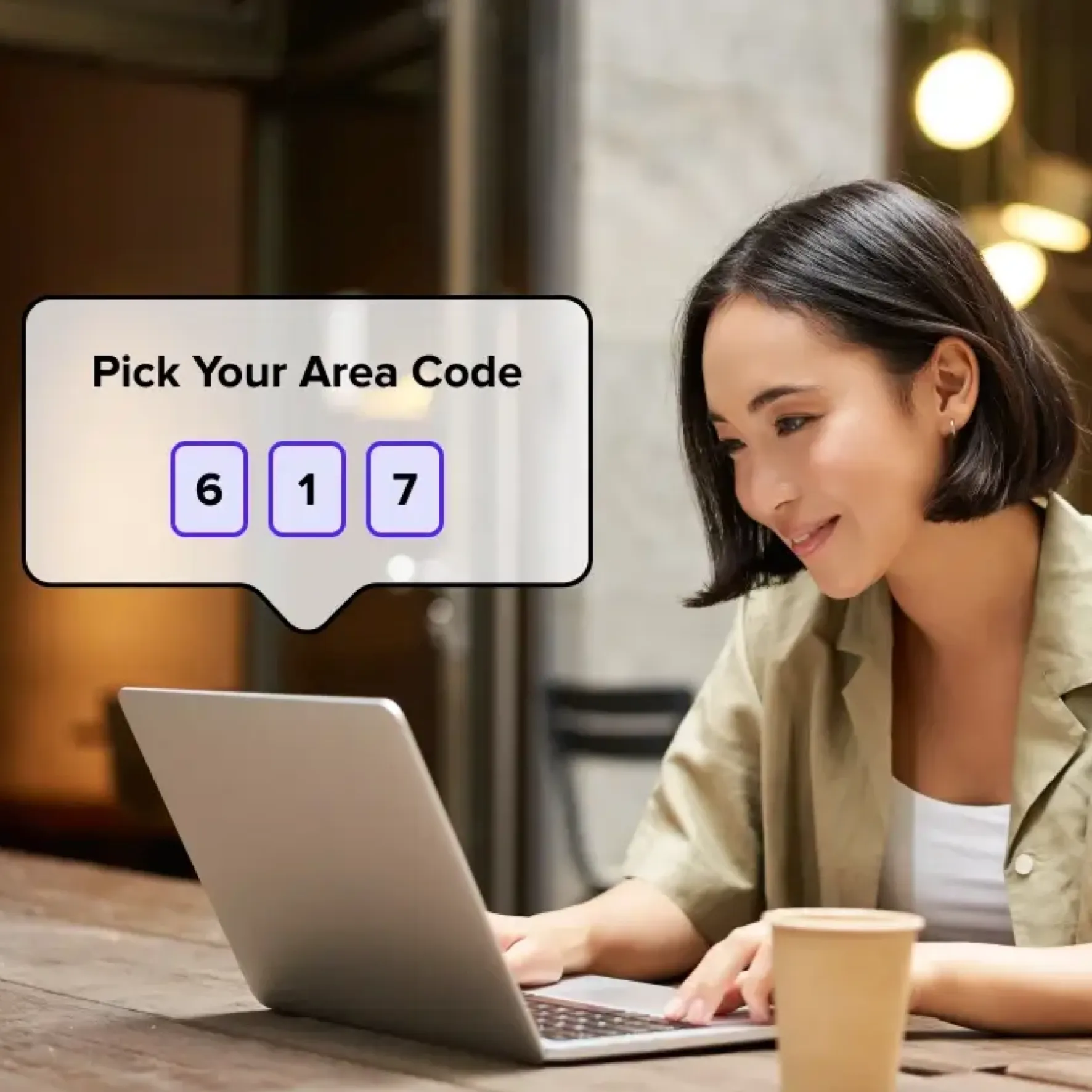
Key Takeaways:
• What it is: An "area code number" is a U.S. phone number whose 3-digit prefix matches a specific metro — 212 for Manhattan, 305 for Miami, 415 for San Francisco, 312 for Chicago, and so on. Businesses use a local area code to look local to local customers.
• Why it matters: Caller-ID apps and customer habits in 2026 treat out-of-area calls as likely spam. A local area code raises answer rates, lifts customer trust, and pairs with the FCC's STIR/SHAKEN framework to keep your call from being labeled "Spam Likely."
• How to get one without moving: SLYNUMBER assigns real U.S. mobile numbers in your chosen area code through the regulated North American Numbering Plan. No relocation, no carrier change, no local address required.
• Quick next step: Download the SLYNUMBER app on iOS or Android, or visit slynumber.com/app/register to claim your business area code in under 5 minutes.
1. What is a business area code number?
An area code is the 3-digit prefix at the front of a U.S. phone number — the part that comes before the 7-digit local number. Area codes are assigned by the Federal Communications Commission through the North American Numbering Plan (NANP), and each one is associated with a specific geographic region: a state, a metro, or in dense markets like New York City, a specific borough.
A business area code number is simply a business line whose area code matches the market the business serves. A SoHo consultancy with a (212) Manhattan line, a Miami real-estate agent with a (305), a Bay Area SaaS startup with a (415) — these are all examples of businesses using the area code as a geographic signal. To a customer in that metro, the call looks like it is coming from a neighbor or a nearby business. To a customer outside that metro, the call still looks legitimate because the number ties to a recognizable U.S. city rather than a random toll-free or out-of-state line.
2. How a specific area code lifts answer rates and trust
Local numbers look familiar to local customers
The single most reliable predictor of whether a customer answers an unknown call is whether the caller-ID looks familiar. A (305) number ringing a Miami customer reads as "probably local business." A 1-800 or out-of-state number ringing the same customer reads as "telemarketer." That difference compounds across every sales call, support callback, and appointment reminder you place.
Modern caller-ID apps amplify the signal
Apps like Truecaller, Hiya, and the native iOS/Android spam filters all weight geography heavily when deciding whether to label a call as "Spam Likely" or "Possible Scam." An unknown out-of-area number is much more likely to be flagged. A local number paired with a verified business name through the FCC's STIR/SHAKEN call-authentication framework is much less likely to be flagged.
It pairs with Google Business Profile and Maps listings
When customers search "[business type] near me" on Google, they see a Maps card with the business name, hours, and a phone number. A local area code on that card is one of the small trust signals that turn a click into a call. An out-of-state number on the same card weakens the local-business framing.
It lowers the friction on outbound sales and support
For any business doing outbound calling — sales, real estate, recruiting, contractors, agencies — answer rate is the entire game. A local area code is not a magic bullet, but it is one of the cheapest answer-rate improvements available, and it stacks with branded caller-ID and verified-business attestation under STIR/SHAKEN.
3. Risks of using the wrong area code (or none) for your business
Most small businesses default to whatever number their carrier hands them when they buy a SIM — usually based on the owner's home address, not the market the business actually serves. That mismatch quietly costs answer rates, trust, and revenue. Here are the three concrete risks worth understanding.
-
Out-of-area numbers get flagged as spam on every call
If your business serves Miami clients but your carrier number is a (713) Houston line because that is where you live, every outbound call to a Miami prospect looks like an out-of-state call. iOS, Android, and third-party caller-ID apps all weight that geography signal when deciding whether to surface "Spam Likely" or "Unknown" to the recipient. The call still places, but it goes unanswered more often.
The FCC's STIR/SHAKEN call-authentication framework, mandated by the TRACED Act, was specifically designed to help carriers and apps separate legitimate calls from spoofed or low-trust calls — and geographic mismatch between the caller's number and the calling region is one of the trust signals carriers feed into the framework.
Why a SLYNUMBER local area code helps: You pick the area code that matches the market you serve, not the city your home address sits in. The geographic signal lines up with the call.
-
A toll-free 800 number is not actually "local"
Many small businesses default to a 1-800 toll-free number thinking it looks professional. It does — but it also looks generic. Customers cannot tell whether a 1-800 call is coming from a nearby real-estate broker or a robocall in Bangalore, so toll-free callers are answered at a noticeably lower rate than local-area-code callers in most consumer-facing categories.
The FTC's 2023 Consumer Sentinel Network data recorded $2.7 billion in phone-based fraud losses, with most of those calls coming from toll-free, spoofed, or unfamiliar numbers — exactly the kind of caller ID that conditions consumers to ignore unknown 1-800 calls.
Why a SLYNUMBER local area code helps: A real local number tied to a real business name through STIR/SHAKEN attestation gives consumers a reason to pick up. Toll-free still has its place for inbound, but for outbound it underperforms a local line.
-
Using your personal cell as the business line leaks your identity
Putting your personal carrier number on your website, Google Business Profile, and marketing collateral makes the number searchable in dozens of people-search and data-broker databases. Anyone — a competitor, a disgruntled customer, a scammer — can plug it into Spokeo or BeenVerified and pull up your name, home address, relatives, and prior addresses in seconds.
The FCC's consumer guide to area codes notes that area codes are public information by design, which is why a personal cell used as a business line creates a stable, public hook into the rest of your private records.
Why a SLYNUMBER local area code helps: A SLYNUMBER is provisioned to your account, not your name or home address, so it never appears in the data-broker records that link a phone number back to your private identity.
4. Everyday business benefits of a specific area code
Establish Local Presence in Any Metro Without Moving
An agency in Austin can pick a (212) New York line and instantly look local to East-Coast prospects. A solo real-estate broker in San Diego can carry a (415) San Francisco number for Bay-Area listings. The geographic signal is the strongest one in caller-ID, and you control it the moment you pick the area code.
Match Multiple Markets With Multiple Lines
If you serve more than one metro, you can run more than one area code from the same SLYNUMBER app on the same iPhone or Android — for example a (212) for New York, a (305) for Miami, and a (415) for San Francisco — each with its own caller ID, voicemail greeting, and call-forwarding rules. One device, three local presences.
Keep Your Personal Cell Off Your Business Card
A dedicated business area code line means your customers, your Google Business Profile, your Meta Business page, and your invoices all show the SLYNUMBER — not the carrier number tied to your home address. When you sell the business, move cities, or simply stop answering work calls after hours, the line is portable and disposable in a way a personal cell never is.
5. How to set up a specific area code business number in 5 steps:
- Download the SLYNUMBER app. Install SLYNUMBER from the App Store (iOS) or Google Play (Android). The app runs on every recent iPhone, Samsung Galaxy, Google Pixel, OnePlus, and Motorola device.
- Create your account. Sign up with your business email address. No carrier information is required, and your personal cell line is not touched or modified.
- Choose your area code. Pick a real U.S. mobile number in the area code you want — (212) New York, (305) Miami, (415) San Francisco, (312) Chicago, (213) Los Angeles, (713) Houston, (404) Atlanta, or any other available U.S. metro. No premium charge for popular codes.
- Select a plan. Plans start at $4.99 per month on the quarterly billing cycle ($14.99 billed every three months). Annual is $49.99/year. Every plan includes calling, SMS, MMS, voicemail, call forwarding, and international dialing.
- Publish your new line. Put the SLYNUMBER on your Google Business Profile, Meta Business page, website footer, email signature, and business cards. Inbound calls and SMS land in the SLYNUMBER app on your existing device.
6. Specific area code number options compared
There are four common ways small businesses end up with a "local area code" line. Here is how they compare on the features that matter most for answer rate, trust, and ongoing flexibility.
| Feature |
SLYNUMBER |
Google Voice |
Burner Apps |
Carrier 2nd line |
| Real U.S. mobile number | Yes | No | Varies | No |
|---|
| SMS verification for apps | Yes | Limited | Often blocked | Yes |
|---|
| Immune to SIM swapping | Yes | Yes | Yes | No |
|---|
| Custom voicemail | Yes | Yes | Rarely | Yes |
|---|
| International calling | Yes | Limited | Rarely | Carrier dependent |
|---|
| eSIM / Data plans | Yes | No | No | Carrier dependent |
|---|
| Number permanence | Permanent | Permanent | Temporary | Permanent |
|---|
| Requires carrier number | No | Yes | Varies | Yes |
|---|
| Starting price | $14.99 / 3 months | Free | $2–$5/week | $10–$15 add-on |
|---|
Quick recap: SLYNUMBER offers real U.S. mobile numbers in nearly every U.S. area code starting at $14.99 every three months, with no premium for popular metro codes like 212 or 415. Google Voice is free but provides VoIP-flagged numbers that some business platforms reject, and signup requires a U.S. carrier line. Burner apps ($2–$5/week) issue temporary numbers that business verification systems often block. A carrier 2nd line ($10–$15 add-on) gives a real number but you cannot freely pick the area code, and the line inherits SIM-swap risk plus a hard-to-cancel carrier contract.
7. Features and pricing
Core Features
SLYNUMBER provides real U.S. mobile numbers — not VoIP-flagged lines that business platforms routinely block. Each business area-code number supports:
• SMS and MMS messaging, including verification codes from Google, Meta, Stripe, Shopify, and Square
• Inbound and outbound voice calls with a local caller ID
• Custom voicemail greetings per number (one greeting per market)
• Call routing, forwarding, and per-contact blocking
• International calling to 100+ countries
• Number tagging by market: New York line, Miami line, San Francisco line, etc.
• eSIM data plans for cellular connectivity in 150+ countries without a local SIM
SLYNUMBER numbers are accepted by every major business and verification service tested, including Google Business Profile, Meta Business Suite, Stripe, Shopify, Square, Mailchimp, HubSpot, and standard banking apps.
Security
Calls and messages are transmitted over encrypted connections using Transport Layer Security (TLS) — the same standard that protects online banking — and Secure Real-Time Transport Protocol (SRTP), which encrypts voice in transit. The number is not linked to your name, home address, or billing details in public databases.
Pricing
SLYNUMBER offers three billing cycles, all with the same full feature set:
• Quarterly: $4.99/month, billed as $14.99 every three months
• Annual: $49.99/year — lowest per-month rate
• Add-on credits: $10 for 1,000 credits (1 credit = 1 minute call, 1 SMS, or 1 MMS)
Platform availability
The SLYNUMBER app is available on the App Store and Google Play Store. SLYNUMBER also includes SlyAI, a built-in AI assistant for instant help and conversational support inside the app.
8. Frequently asked questions
An area code is the 3-digit prefix at the start of a U.S. phone number — for example, 212 for Manhattan or 415 for San Francisco. It signals geography to anyone seeing the caller ID. For businesses, a local area code raises answer rates with nearby customers because the call no longer looks like spam, telemarketing, or a long-distance pitch from somewhere unfamiliar.
Yes. SLYNUMBER provisions real U.S. mobile numbers through the regulated North American Numbering Plan in nearly every U.S. area code, so you can pick a (212) New York, (305) Miami, (415) San Francisco, or (312) Chicago number from anywhere in the world. No local address, no relocation, and no carrier change is required.
Yes. Multiple sales and outreach studies consistently report that calls from a local area code are answered at a noticeably higher rate than calls from an unfamiliar or out-of-state number, primarily because modern caller-ID apps and consumer habits treat out-of-area calls as likely spam. Pairing the area code with a verified business name (under the FCC's STIR/SHAKEN framework) further reduces the chance the call is flagged.
Yes. Many SLYNUMBER users run one number per metro — for example a (212) for New York clients, a (305) for Miami, and a (415) for San Francisco — all on the same iPhone or Android device. Each number has its own caller ID, voicemail greeting, and routing rules, so the right local presence shows up on every call.
Yes. SLYNUMBER numbers are issued as real U.S. mobile numbers, not VoIP-flagged lines, so they accept SMS verification codes from business platforms like Google Business Profile, Meta Business Suite, Stripe, Shopify, and Square. The area code does not affect the verification — what matters is that the line is a real mobile number, which SLYNUMBER guarantees.
SLYNUMBER plans start at $4.99 per month on the quarterly billing cycle ($14.99 billed every three months). An annual plan is available at $49.99/year. Every plan includes calling, SMS, MMS, voicemail, call forwarding, and your choice of any available U.S. area code — there is no premium for a popular metro code like 212 or 415.