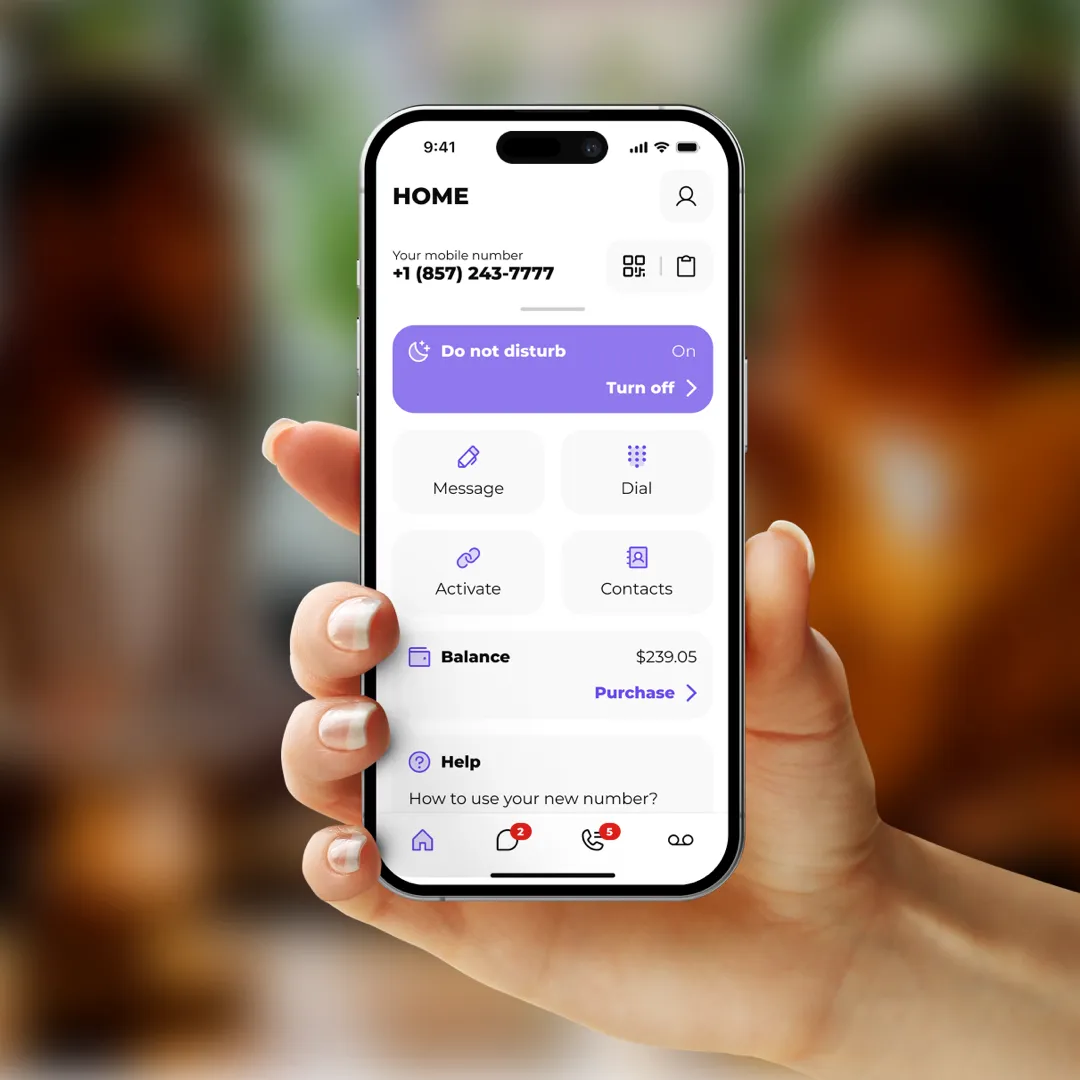
Key Takeaways:
• What it means: "Two phone numbers on one phone" means a single device — iPhone, Samsung Galaxy, Google Pixel, OnePlus, or Motorola — runs two separate phone numbers, each with its own caller ID, SMS inbox, and voicemail.
• Three modern paths: Dual SIM (physical + eSIM, or two eSIMs), a carrier "second line" add-on ($10–$15/month), or an app-based virtual second number like SLYNUMBER ($4.99/month).
• Why a virtual number wins for most people: No SIM swap, no carrier contract, no extra device, and the second number is immune to SIM-swap attacks because it lives in the cloud — not on a carrier's switch.
• Quick next step: Download the SLYNUMBER app on iOS or Android, or visit slynumber.com/app/register to add your second number in under 5 minutes.
1. Can you have two phone numbers on one phone?
Yes — every recent iPhone and almost every Android device released in the last five years can host two phone numbers on the same hardware. The real question is not whether it is possible, but which of the three working paths fits your needs in 2026.
The first path is Dual SIM. Every iPhone since the XS supports two lines through one physical SIM plus one eSIM, and Samsung Galaxy, Google Pixel, OnePlus, and Motorola devices ship with either dual physical SIM trays or dual eSIM profiles. The second path is a carrier "second line" add-on — Verizon, AT&T, and T-Mobile all sell a second eSIM line for $10–$15 per month that piggybacks on your existing plan. The third path is an app-based virtual number like SLYNUMBER, which provisions a real U.S. mobile number in the cloud and routes it to an app on your phone over Wi-Fi or mobile data using Voice over Internet Protocol (VoIP) — phone calls delivered as encrypted data packets over the internet rather than over your carrier's voice channel. All three approaches give you two numbers on one device, but they diverge sharply on cost, SIM-swap exposure, and how easily you can walk away.
2. How a second number on one phone actually works
Option 1: Dual SIM (Physical SIM + eSIM, or Two eSIMs)
You buy a SIM from a second carrier — or activate a second eSIM profile from the same carrier — and your device routes voice and data through whichever line you choose per call. The hardware handles the switching. You manage two carrier relationships and pay two monthly bills.
Option 2: Carrier "Second Line" Add-On
Your existing carrier (Verizon, AT&T, T-Mobile, or a regional MVNO) issues a second eSIM under your existing plan for an additional $10–$15 per month. You receive a single consolidated bill, but the second line is fully managed by the carrier — including the parts you cannot opt out of, like SIM-swap exposure and a phone-call cancellation process.
Option 3: App-Based Virtual Number (SLYNUMBER)
You install the SLYNUMBER app from the App Store or Google Play, and the service provisions a real U.S. mobile number from the regulated North American Numbering Plan. The number is anchored to a software switch in a data center — not to a SIM card. Calls and SMS travel as encrypted data packets over Transport Layer Security (TLS), the same standard that protects online banking, and Secure Real-Time Transport Protocol (SRTP) for voice.
The common ground
In all three cases, your device shows two phone numbers with two separate caller IDs and two inboxes. Where they diverge is everything else: setup time (minutes vs. days), recurring cost ($4.99 vs. $10–$30+/month), SIM-swap risk, and how easily you can walk away when the second line is no longer needed.
3. Pitfalls of dual-SIM and carrier-eSIM second lines
Dual SIM and carrier-issued second lines feel like the obvious path — same provider, same bill, same SIM tray. But three concrete downsides rarely make it into the carrier brochure, and they shape whether the line will still be worth keeping a year from now.
-
Carrier-controlled second lines remain vulnerable to SIM swapping
A second line issued by your carrier is still a carrier-controlled number — which means it can be socially engineered out from under you. A scammer who calls your carrier and convinces a representative they are you can port the line to a SIM they control and intercept every verification code that follows. This is the same attack vector that drained an estimated $72 million from U.S. consumers in 2022, often hitting bank, email, and cryptocurrency accounts that rely on SMS-based two-factor authentication (2FA).
The FBI's Internet Crime Complaint Center (IC3) reported SIM-swap losses growing from roughly $12 million in 2018 to over $72 million in 2022 — a sixfold increase, driven by attacks on bank, email, and crypto accounts that use SMS-based 2FA on carrier numbers.
Why a virtual second number helps: A SLYNUMBER is not held by a mobile carrier, so the SIM-swap attack vector simply does not apply. There is no carrier representative to socially engineer, and the number cannot be ported by a phone call.
-
Switching carriers drags both lines with it
If you decide to leave Verizon for T-Mobile (or vice versa), you have to deal with both your primary number and the second line at the same time. Porting takes days, sometimes carries fees, and in the worst case strands you between carriers right when you most need a working line. A virtual second number is portable in the sense that it does not matter — it lives in the cloud, so switching primary carriers does nothing to it.
The U.S. National Institute of Standards and Technology classifies SMS-based two-factor authentication tied to carrier-controlled lines as a "restricted" authenticator in Special Publication 800-63B, partly because of the operational fragility of carrier-bound numbers during ports and swaps.
Why a virtual second number helps: Switching primary carriers has zero effect on your SLYNUMBER. The second line is decoupled from your carrier relationship entirely, so a carrier change never pulls it offline.
-
Carrier second lines are hard to walk away from
Most carrier second-line add-ons require a phone call to cancel and may push back-end charges through to your next bill cycle. A virtual second number can be paused or canceled inside the app, today, with no friction. That matters if you only need the second number for a project, a relocation, a trip, or a single season of life — and it especially matters if you forget about the line entirely.
The FTC's 2023 Consumer Sentinel Network data recorded phone-based fraud as the single largest reported scam category, with $2.7 billion in consumer losses — a reminder that a forgotten, unmonitored carrier line is an attack surface, not a feature.
Why a virtual second number helps: You can pause, cancel, or swap your SLYNUMBER from inside the app — no phone call, no retention script, no surprise bill the following month.
4. Everyday benefits of two numbers on one device
One Phone, Two Lives
Carry a single device and split your communications cleanly: the work line on the SLYNUMBER app, the personal line on your carrier — or vice versa. Each number gets its own caller ID, voicemail greeting, and notification rules, so a Saturday text from a client never lights up your family thread, and a parent's call never interrupts a deep-work block. No second iPhone in your pocket, no swapping SIMs at airport gates.
Travel With a U.S. Number That Never Roams
Because SLYNUMBER routes over the internet, your U.S. number rings on hotel Wi-Fi in Tokyo just as easily as on home Wi-Fi in Austin — no roaming charges, no carrier hand-off, no "I'll call you when I land." You can also activate a SLYNUMBER eSIM data plan to get local cellular data abroad in 150+ countries without buying a tourist SIM at the airport or paying $10/day in carrier roaming fees.
Run a Side Business Without Forking Your Identity
Selling on Etsy, freelancing on Upwork, running a consultancy, or moderating an online community? A SLYNUMBER second line gives you a professional presence — with a custom voicemail greeting and a chosen area code (212 for New York, 305 for Miami, 415 for San Francisco) — without bolting another carrier contract onto your life or handing your personal number to customers who may post it publicly.
5. How to set up a second phone number in 5 steps:
- Download the SLYNUMBER app. Install SLYNUMBER from the App Store (iOS) or Google Play (Android). It runs on every recent iPhone, Samsung Galaxy, Google Pixel, OnePlus, and Motorola device.
- Create your account. Sign up with an email address. No carrier information is requested, and your existing carrier line is not modified or touched.
- Choose your second number. Pick a real U.S. mobile number and select any available area code — 212 for New York, 305 for Miami, 415 for San Francisco, or any other code. Your carrier number's area code is unaffected.
- Select a plan. Plans start at $4.99 per month on the quarterly billing cycle ($14.99 billed every three months). Monthly and annual options are also available.
- Start using both numbers. Calls, SMS, MMS, and voicemail on your second number live inside the SLYNUMBER app; your carrier line continues to work in your default Phone and Messages apps. Switching between them takes a single tap.
6. Two-number options for one phone compared
Here is how the major paths to two numbers on one device compare across the features that matter most when adding a second line — and the friction points that show up after the first month.
| Feature |
SLYNUMBER |
Google Voice |
Burner Apps |
Carrier 2nd line |
| Real U.S. mobile number | Yes | No | Varies | No |
|---|
| SMS verification for apps | Yes | Limited | Often blocked | Yes |
|---|
| Immune to SIM swapping | Yes | Yes | Yes | No |
|---|
| Custom voicemail | Yes | Yes | Rarely | Yes |
|---|
| International calling | Yes | Limited | Rarely | Carrier dependent |
|---|
| eSIM / Data plans | Yes | No | No | Carrier dependent |
|---|
| Number permanence | Permanent | Permanent | Temporary | Permanent |
|---|
| Requires carrier number | No | Yes | Varies | Yes |
|---|
| Starting price | $14.99 / 3 months | Free | $2–$5/week | $10–$15 add-on |
|---|
Quick recap: SLYNUMBER provides real U.S. mobile numbers starting at $14.99 every three months, accepts SMS verification for all major apps (WhatsApp, banking, social media), is immune to SIM-swap attacks, and includes eSIM data plans in 150+ countries. Google Voice is free but provides VoIP-flagged numbers with limited app verification and U.S.-only signup. Burner apps ($2–$5/week) issue temporary numbers that services often block outright. A carrier 2nd line ($10–$15 add-on) gives a real number but inherits SIM-swap risk and requires an active carrier account.
7. Features and pricing
Core Features
SLYNUMBER provides real U.S. mobile numbers — not VoIP-flagged numbers that apps and services routinely block. Each number supports:
• SMS and MMS messaging, including app verification codes
• Inbound and outbound voice calls
• Custom voicemail greetings per number
• Call routing, forwarding, and per-contact blocking
• International calling to 100+ countries
• Number tagging by purpose: business, personal, dating, or travel
• eSIM data plans for cellular connectivity in 150+ countries without a local SIM
SLYNUMBER numbers are accepted by every major app and service tested, including WhatsApp, Telegram, PayPal, Venmo, Instagram, Snapchat, Amazon, Tinder, Bumble, and Gmail.
Security
Calls and messages are transmitted over encrypted connections using Transport Layer Security (TLS) — the same encryption standard that protects online banking — and Secure Real-Time Transport Protocol (SRTP), which encrypts voice data in transit. The number is not linked to your name, home address, or billing details, so reverse-lookup tools cannot identify you from it.
Pricing
SLYNUMBER offers three billing cycles, all of which include the same full feature set:
• Quarterly: $4.99/month, billed as $14.99 every three months
• Annual: $49.99/year — lowest per-month rate
• Add-on credits: $10 for 1,000 credits (1 credit = 1 minute call, 1 SMS, or 1 MMS)
Platform availability
The SLYNUMBER app is available on the App Store and Google Play Store. SLYNUMBER also includes SlyAI, a built-in AI assistant for instant help and conversational support inside the app.
8. Frequently asked questions
Yes. Every recent iPhone and almost every modern Android device can run two phone numbers on one device. The three working paths in 2026 are Dual SIM (physical SIM + eSIM, or two eSIMs), a carrier "second line" add-on, and an app-based virtual number like SLYNUMBER. Each gives you two distinct caller IDs, two SMS inboxes, and two voicemail boxes on a single handset.
The fastest method is an app-based virtual number. With SLYNUMBER, you install the app from the App Store or Google Play, sign up with an email address, and pick a real U.S. mobile number — the full setup takes under 5 minutes with no SIM swap, no carrier appointment, and no second device required.
Yes. SLYNUMBER issues real U.S. mobile numbers from the regulated North American Numbering Plan, so SMS verification codes from WhatsApp, Telegram, Tinder, Bumble, Instagram, PayPal, Venmo, your bank, and other major services arrive in the SLYNUMBER inbox the same way they would on a carrier line.
No. A virtual second number runs inside an app on top of whatever SIM configuration you already have. SLYNUMBER works on single-SIM devices, Dual SIM devices, and eSIM-only devices — it does not occupy a SIM slot or an eSIM profile.
Yes. SLYNUMBER supports porting an existing U.S. mobile number into the app, so you can move a personal or business number into the SLYNUMBER cloud and keep it on your current device without staying tied to a carrier contract.
SLYNUMBER plans start at $4.99 per month on the quarterly billing cycle ($14.99 billed every three months). An annual plan is available at $49.99/year. Every plan includes calling, SMS, MMS, voicemail, call forwarding, and international dialing — typically less than a carrier's $10–$15/month second-line add-on.