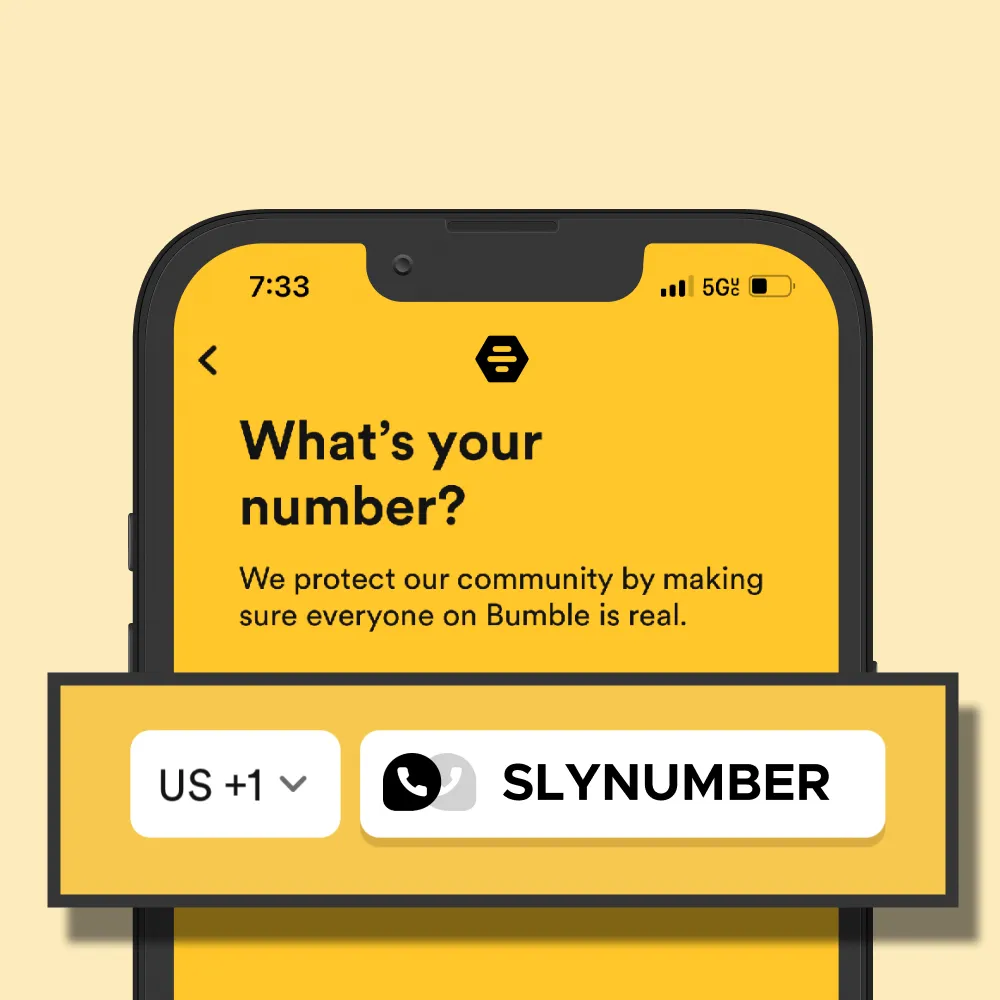
Key Takeaways:
• What works: Bumble accepts any real U.S. mobile number that can receive an SMS verification code — and your number does not have to be your primary carrier line.
• Who should use a second number: First-time daters, returning daters, public-facing professionals, anyone in a small town, and anyone who has had a bad experience after handing out their real cell.
• Primary benefits: Passes Bumble's SMS verification on the first try, keeps your real number off matches' phones and out of data-broker reports, and can be deactivated any time without disrupting your daily life.
• Quick next step: Download the SLYNUMBER app on iOS or Android, or visit slynumber.com/app/register to claim a Bumble-ready U.S. mobile number in under 5 minutes.
Can you use a second phone number for Bumble?
Yes — Bumble accepts a second phone number for both account creation and ongoing verification, as long as that number is classified as a real U.S. mobile line in the carrier database. Bumble's signup flow sends a 6-digit SMS code to whatever number you enter, and its anti-spam system checks the line type before the code is delivered. If the line is flagged as VoIP, the verification fails before the code ever leaves Bumble's servers.
This is exactly where most "free second number" services break. Google Voice and Skype are tagged as VoIP in the Local Number Portability (LNP) database, so Bumble's verification system treats them as untrusted and blocks signup. A SLYNUMBER, by contrast, is provisioned through the regulated North American Numbering Plan (NANP) as a real mobile number — the same classification used by Verizon, T-Mobile, and AT&T — which means Bumble's verification system delivers the SMS code without resistance. With over 25 million active U.S. users on Bumble, that line-type check exists to keep bots out, not to block legitimate daters who simply want to keep their personal cell private.
How Bumble verification works with a second number
Step 1: Bumble asks for a phone number
When you open the Bumble app and tap "Get started," the first screen requests a phone number. That number becomes the unique identifier for your Bumble account — Bumble uses it to prevent duplicate accounts, deliver password resets, and (optionally) match you with people in your contacts.
Step 2: Bumble sends an SMS verification code
Bumble queues a 6-digit code through an SMS aggregator (such as Twilio or Sinch), which inspects the line type before delivery. Real U.S. mobile numbers — including SLYNUMBER — pass this check cleanly. VoIP-flagged numbers from Google Voice, Skype, or TextNow are typically rejected with an "unable to verify" message and a request to enter a different number.
Step 3: You enter the code in the Bumble app
The verification code lands in your SLYNUMBER inbox within seconds. You enter the 6 digits in Bumble, and the account is verified. Bumble then guides you through profile setup (photos, prompts, bio) — none of which exposes your phone number to other users.
Step 4: Conversations stay in-app until you choose otherwise
Bumble matches text inside the app, never over SMS. Your phone number is never shown to matches unless you choose to share it. When you do, you hand over the SLYNUMBER — not your carrier line — so the match can text or call without ever seeing your real cell.
Risks of using your real number on Bumble
Bumble is one of the safer dating platforms — the women-first messaging policy filters out a lot of low-effort harassment — but the phone number you hand it still becomes a potential leak point. These are the three risks worth understanding before you type your real cell into the signup screen.
-
1. Off-app pivots and romance scams
Bumble's safety team actively moderates in-app chat, but scammers know this and try to move the conversation to SMS or WhatsApp as soon as possible. Once they hold your real carrier number, they can run social-engineering attacks — claiming to be in distress, asking for gift cards, or pushing crypto "investments" — without the platform's moderation looking over their shoulder.
The FTC's 2023 Consumer Sentinel Network data recorded $1.14 billion in reported romance-scam losses, with phone-based off-platform messaging cited as the most common pivot point after initial contact on a dating app.
Why a SLYNUMBER second line helps: The number you hand over is a SLYNUMBER — not your real cell. If the conversation turns sour, you cut the contact in the app and the scammer cannot follow you to your bank, your email, or your family.
-
2. Reverse-lookup and doxxing
A real U.S. cell number is searchable across dozens of people-search databases. Anyone who collects it can plug it into a site like Spokeo, BeenVerified, or WhitePages and pull up your full name, prior addresses, and relatives in seconds. For Bumble users in smaller cities or specific professional circles, this is how a casual match quietly becomes a stalker — or how a one-off bad date becomes a permanent harassment problem.
The FTC's data-broker guidance notes that consumer phone numbers are sold alongside names, addresses, and household composition by hundreds of data brokers — making a single Bumble exchange a low-cost gateway into your offline identity.
Why a SLYNUMBER second line helps: A SLYNUMBER does not appear in data-broker databases tied to your legal identity. A reverse search on your dating number returns nothing actionable, so a match cannot trace it back to your home or workplace.
-
3. SIM-swap targeting via dating apps
Sophisticated scammers use dating apps as reconnaissance — they collect names, hometowns, and phone numbers from matches, then attempt SIM-swap attacks against the most lucrative targets to steal banking, email, and crypto accounts. A real carrier number on your Bumble profile is exactly the seed data this attack needs to succeed.
The FBI's Internet Crime Complaint Center (IC3) reported SIM-swap losses growing from roughly $12 million in 2018 to over $72 million in 2022 — driven in part by reconnaissance gathered on dating and social platforms.
Why a SLYNUMBER second line helps: A SLYNUMBER is not held by a mobile carrier and cannot be SIM-swapped. Even if a bad actor obtains it, they cannot pivot to your bank's SMS-based 2FA — that text still goes to a different, private number on your carrier line.
Everyday Bumble benefits of a second number
Match a Local Area Code to the City You Date In
Bumble shows matches based on location, and the area code on your phone often quietly signals the same. A 212 reads as New York, 415 as San Francisco, 312 as Chicago. With SLYNUMBER you can pick any available U.S. area code, so your dating number can match the city you actually swipe in — without ever changing the area code on your primary cell.
Keep Bumble Notifications Out of Your Work Phone
If your primary number sits on a company device, you do not want a Bumble Boost notification surfacing on a Teams call. A SLYNUMBER lives in its own inbox inside the SLYNUMBER app, so Bumble's verification SMS, your matches' eventual texts, and your dating voicemails all stay in one private place.
Reset and Reuse If You Take a Dating Break
Bumble users cycle on and off the app constantly — exclusive relationships, work seasons, mental-health breaks. If you deactivate your Bumble account and come back six months later with a different vibe, you can keep the same SLYNUMBER or claim a new one. Either way, your carrier line never changes and your old matches do not follow you back in.
How to set up a second phone number for Bumble in 5 steps:
- Download the SLYNUMBER app. Install SLYNUMBER from the App Store (iOS) or Google Play (Android).
- Create your account. Sign up with your email address. No carrier information is required, and your existing cell is not modified.
- Choose your number and area code. Pick a real U.S. mobile number. Most Bumble users select an area code that matches the city they live in or actively date in.
- Open Bumble and enter your SLYNUMBER. Start a new Bumble account, or change the number on an existing one under Settings → Account. Enter your SLYNUMBER as the phone number. The verification SMS arrives in the SLYNUMBER inbox within seconds.
- Finish your Bumble profile. Add photos, write prompts, and start swiping. From here, every Bumble notification, every off-app text from a match, and every dating voicemail flows through SLYNUMBER — not your real cell.
Second-number options for Bumble compared
Not every "second number" service actually works for Bumble. Here is how the major options compare on the features that determine whether Bumble will let you verify and remain on the platform.
| Feature |
SLYNUMBER |
Google Voice |
Burner Apps |
Carrier 2nd line |
| Real U.S. mobile number | Yes | Yes | Varies | Yes |
|---|
| SMS verification for apps | Yes | Limited | Often blocked | Yes |
|---|
| Immune to SIM swapping | Yes | Yes | Yes | No |
|---|
| Custom voicemail | Yes | Yes | Rarely | Yes |
|---|
| International calling | Yes | Limited | Rarely | Carrier dependent |
|---|
| eSIM / Data plans | Yes | No | No | Carrier dependent |
|---|
| Number permanence | Permanent | Permanent | Temporary | Permanent |
|---|
| Requires carrier number | No | Yes | Varies | Yes |
|---|
| Starting price | $14.99 / 3 months | Free | $2–$5/week | $10–$15 add-on |
|---|
Quick recap: SLYNUMBER provides real U.S. mobile numbers starting at $14.99 every three months, passes Bumble's SMS verification on the first attempt, is immune to SIM-swap attacks, and includes eSIM data plans in 150+ countries. Google Voice is free but provides VoIP-flagged numbers that Bumble frequently rejects. Burner apps ($2–$5/week) issue temporary numbers that dating platforms often block outright. A carrier 2nd line ($10–$15 add-on) gives a real number but inherits SIM-swap risk and requires an active carrier account.
Features and pricing
Core Features
SLYNUMBER provides real U.S. mobile numbers — not VoIP-flagged numbers that Bumble and other dating apps routinely block. Each number supports:
• SMS and MMS messaging, including dating-app verification codes
• Inbound and outbound voice calls
• Custom voicemail greetings per number
• Call routing, forwarding, and per-contact blocking
• International calling to 100+ countries
• Number tagging by purpose: dating, business, personal, or travel
• eSIM data plans for cellular connectivity in 150+ countries without a local SIM
SLYNUMBER numbers are accepted by every major dating and verification service tested, including Bumble, Tinder, Hinge, Match, WhatsApp, Telegram, PayPal, Venmo, Instagram, and Gmail.
Security
Calls and messages are transmitted over encrypted connections using Transport Layer Security (TLS) — the same encryption standard that protects online banking — and Secure Real-Time Transport Protocol (SRTP), which encrypts voice data in transit. The number is not linked to your name, home address, or billing details, so reverse-lookup tools used by would-be stalkers cannot identify you from it.
Pricing
SLYNUMBER offers three billing cycles, all of which include the same full feature set:
• Quarterly: $4.99/month, billed as $14.99 every three months
• Annual: $49.99/year — lowest per-month rate
• Add-on credits: $10 for 1,000 credits (1 credit = 1 minute call, 1 SMS, or 1 MMS)
Platform availability
The SLYNUMBER app is available on the App Store and Google Play Store. SLYNUMBER also includes SlyAI, a built-in AI assistant for instant help and conversational support inside the app.
Frequently asked questions
Yes. Bumble accepts any real U.S. mobile number that can receive an SMS verification code. A SLYNUMBER is issued through the regulated North American Numbering Plan as a real mobile number, so Bumble treats it like any other carrier line during signup, password recovery, and account verification.
No. Bumble's verification system rejects VoIP-flagged numbers in most cases, and both Google Voice and Skype are tagged as VoIP in the Local Number Portability database. Users who try those services typically see a "we couldn't verify your number" error. SLYNUMBER avoids this issue because the line is provisioned as a real U.S. mobile number, not VoIP.
Bumble never shows your phone number to other users — all chat happens inside the Bumble app. When you decide to share a number with a match, you give them the SLYNUMBER instead of your carrier line, so your real cell stays private.
Yes. In Bumble, go to Settings → Account → Phone Number, enter your SLYNUMBER, and confirm the SMS verification code that arrives in the SLYNUMBER app. Your match history, photos, and profile prompts all stay intact — only the phone number on file changes.
Unmatch and block the user inside Bumble. If they already have your SLYNUMBER and continue to harass you, block them at the SLYNUMBER app level — or deactivate the dating number entirely and pick a new one. Your real carrier line never changes.
SLYNUMBER plans start at $4.99 per month on the quarterly billing cycle ($14.99 billed every three months). An annual plan is available at $49.99/year. Every plan includes SMS verification for Bumble and other dating apps, calling, MMS, voicemail, and call forwarding.